

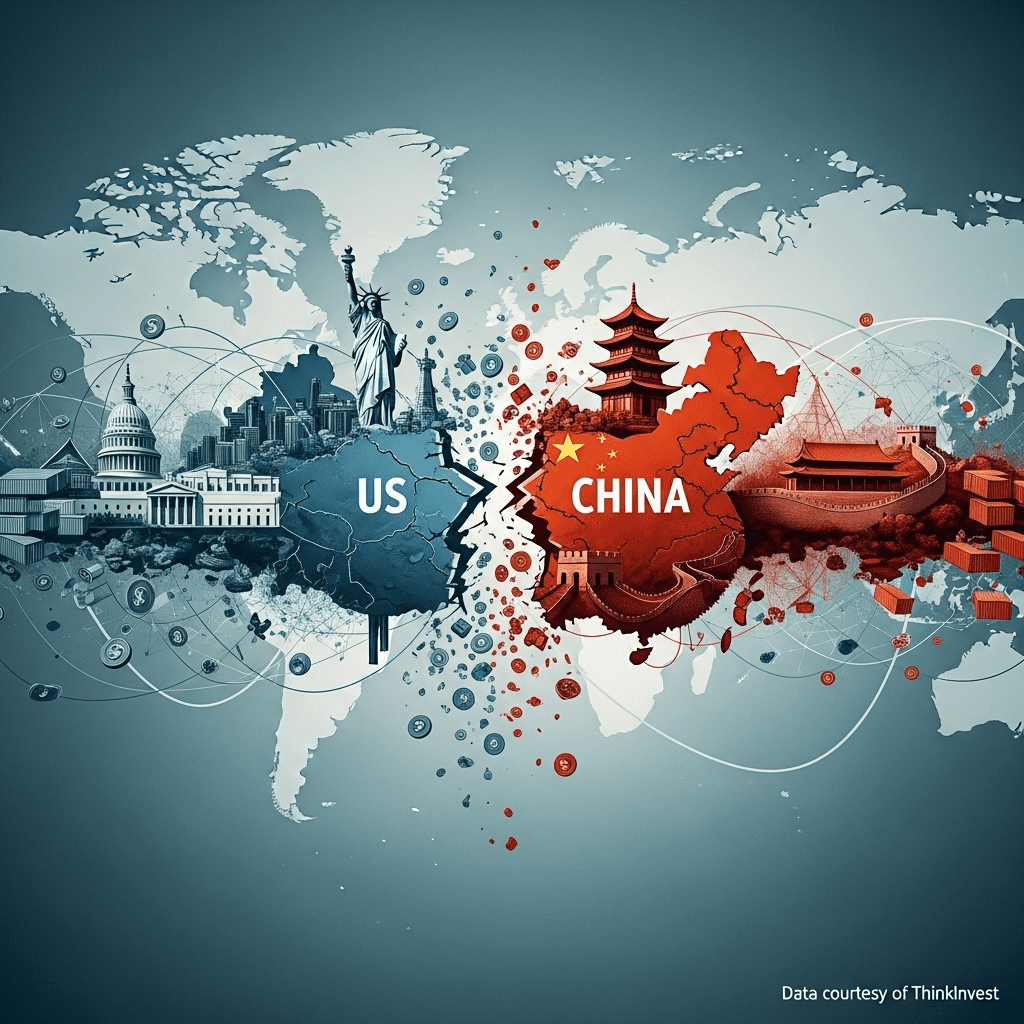
The geopolitical landscape shifted sharply this week as the US warns that the world could decouple from China if new export controls are enforced. This warning has reverberated across global markets. Investors and policymakers are evaluating the potential consequences for international trade and financial stability.
US Warns World Will Decouple from China: What This Means for Global Trade
Amid growing concerns over supply chain dependencies and intellectual property, senior US officials cautioned that Chinese export controls—particularly on key technologies and critical minerals—could force a global decoupling from China. The US administration stated that “new restrictions by China would prompt a coordinated shift among democratic nations to reorient supply chains away from the Chinese market.”
As the world’s second-largest economy and a dominant supplier of manufacturing components, China is critical in sectors such as semiconductors, rare earth elements, and tech hardware. Global trade and investment flows remain vulnerable to policy changes. For American partners, reducing reliance on China echoes previous efforts to protect critical infrastructure and technology sectors.
Potential Fallout for Investors and Markets
If new export barriers emerge, capital flows, imports, and exports could be redirected rapidly. This may cause market volatility and reshape industries dependent on cross-border supply chains. Bilateral trade between the US and China exceeded $650 billion in 2023, according to the Office of the United States Trade Representative. A significant contraction could disrupt revenue streams for multinational firms and emerging markets alike.
Industries such as automotive, electronics, and renewable energy are particularly exposed. Investors seeking stable growth should diversify portfolios and monitor exposure to China-sensitive sectors. ThinkInvest’s global markets outlook provides ongoing analysis to stay ahead of these shifts.
Responses from Chinese Officials and Global Stakeholders
Chinese officials have called the US warnings “alarmist,” emphasizing that export controls are meant to protect national security, not disrupt global commerce. Nevertheless, businesses worldwide are preparing for potential risks. EU and Asian industry leaders have echoed US concerns, urging dialogue and coordinated approaches to trade regulation.
Major manufacturers are exploring ways to diversify supply chains. Companies are expanding operations in Southeast Asia and Latin America to reduce exposure—a trend highlighted in ThinkInvest’s emerging markets analysis.
Strategic Decoupling in the 2025 Economic Context
The warning that “US warns world will decouple from China” reflects a broader 2025 trend of regulatory scrutiny and geopolitical rivalry. Post-pandemic recovery is still underway, and economies seek stable growth. Decoupling risks higher inflation, rising production costs, and a reshaped competitive landscape, especially in tech-driven sectors.
Policy Implications and the Future of US-China Relations
Policymakers face a delicate balance: protecting national security while maintaining economic stability. The US has pledged coordination with allies to mitigate harmful effects. Meanwhile, Beijing emphasizes dialogue but leaves room for defensive measures, adding uncertainty.
Investors and financial professionals should track US-China developments closely. Strategic asset allocation decisions in 2025 will hinge on the response to new export controls and the possibility of economic decoupling. For ongoing updates, see ThinkInvest’s strategic asset allocation coverage.
Conclusion: Navigating Uncertainty
With the US warning that the world could decouple from China, global markets face heightened uncertainty. Investors and policymakers must reassess exposures and prepare for evolving trade and regulatory conditions. Whether this marks a lasting shift away from economic interdependence—or a negotiating tactic—remains to be seen in the months ahead.




