

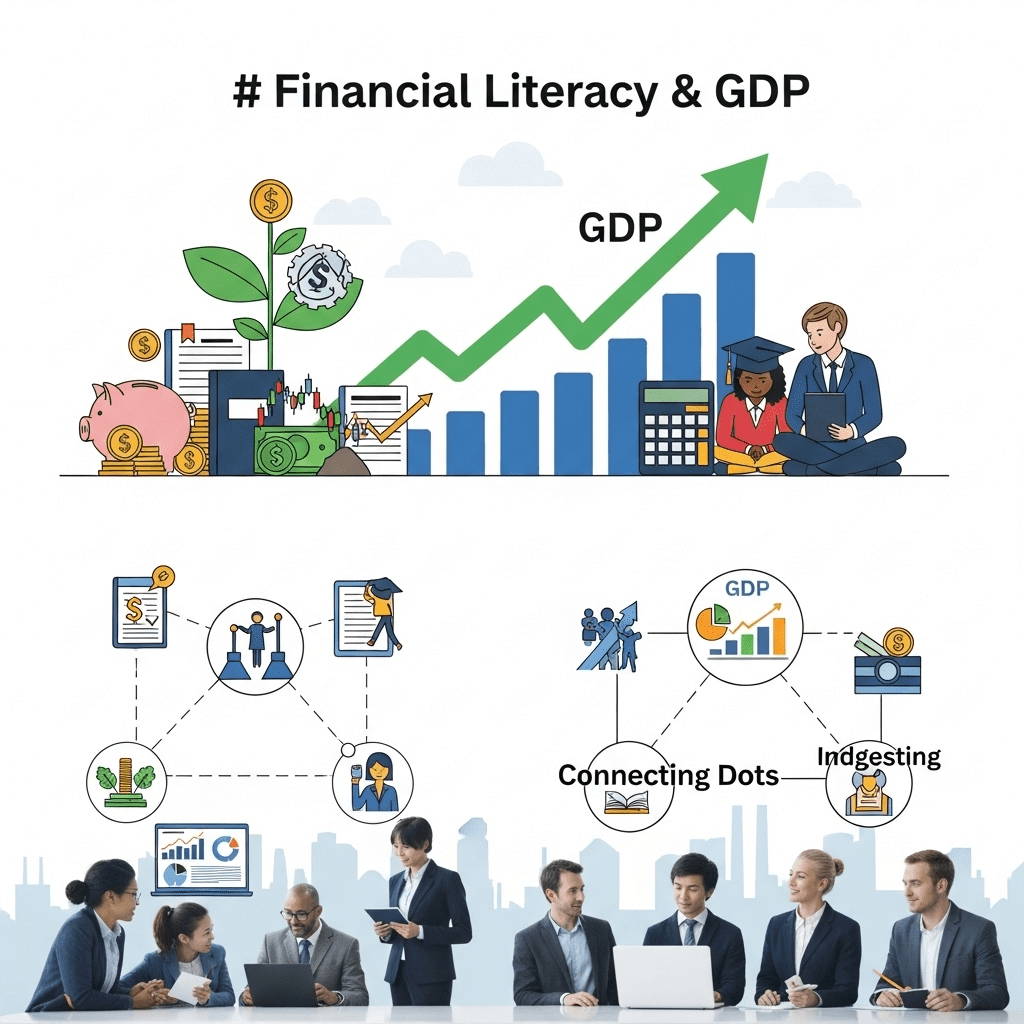
As financial markets evolve and economies face mounting complexities in 2025, economists and policymakers are increasingly asking whether financial literacy could boost GDP on a national scale. With global competitiveness tied to household savings, investment rates, and entrepreneurial activity, the impact of a financially educated population on gross domestic product (GDP) is drawing renewed scrutiny. Could widespread financial education play a transformative role in driving sustainable economic growth?
The Link: How Financial Literacy Could Boost GDP
Financial literacy is defined as the ability to understand and apply key financial skills such as budgeting, investing, and risk management. Research indicates that populations with higher financial literacy are more likely to make informed financial decisions, save efficiently, invest prudently, and avoid high-cost debt. If scaled nationwide, these individual behaviors aggregate into powerful economic outcomes—raising the question: How can financial literacy boost GDP?
One pathway is through increased savings rates. Households with strong financial skills tend to set aside more money, creating larger pools of capital for banks to lend to businesses. This process fuels entrepreneurship, innovation, and job creation, directly feeding into GDP growth. Furthermore, better-informed investors may allocate their resources toward productive sectors, increasing economy-wide efficiency.
Reducing Economic Vulnerability
Financially literate populations are also less prone to fall victim to fraud, predatory lending, or excessive borrowing. According to the OECD, countries with higher average financial knowledge scores displayed lower household debt as a percent of GDP. Reducing over-indebtedness lowers default rates, protects financial institutions, and enhances the overall stability and resilience of an economy—a core concern for governments seeking financial stability in volatile times.
Potential GDP Gains from Greater Financial Knowledge
Empirical studies offer compelling evidence that financial literacy could boost GDP. A 2024 report by the World Bank suggested that improving financial literacy scores by just 10% across a country could lift GDP growth by 0.3 to 0.5 percentage points annually. This is achieved not only via increased investment rates but also through improved labor productivity. Workers who manage personal finances capably are less likely to be distracted by money worries, translating to higher output at work.
In emerging markets, the effects can be even more pronounced. Financial education initiatives in Southeast Asia and Sub-Saharan Africa have shown that even modest interventions, such as incorporating financial curriculum in schools or adult workshops, correlate with measurable GDP increases within a decade.
Challenges and Policy Imperatives
While the consensus is growing around the idea that financial literacy could boost GDP, challenges remain. Socioeconomic disparities can limit access to quality financial education, and persistent gender gaps may hold back aggregate economic progress. Policymakers are increasingly advocating for universal financial education as part of national curriculums, alongside public-private partnerships to reach underserved communities.
Integrating Financial Literacy into Economic Growth Strategies
The case for integrating financial literacy initiatives into long-term economic policy is stronger than ever for 2025. Beyond classroom education, new digital platforms and AI-powered financial apps empower individuals to better understand credit, asset management, and long-term financial planning—all crucial skills in a world of rapid technological change.
For investors, recognizing the link between a country’s financial education level and its economic trajectory offers new opportunities to assess sovereign credit risk and growth potential. In a recent IMF analysis, countries that scored high on financial literacy indices also attracted more stable foreign direct investment and benefited from higher capital formation.
The Road Ahead: A Win-Win for Households and Nations
Ultimately, the proposition that financial literacy could boost GDP is more than an academic hypothesis—it is a policy imperative. As governments and stakeholders focus on post-pandemic economic resilience and long-term competitiveness, investing in comprehensive financial education may prove one of the most cost-effective levers for growth. The ripple effects extend from household prosperity to national stability—making financial literacy a cornerstone of economic strategy in the years ahead.




