

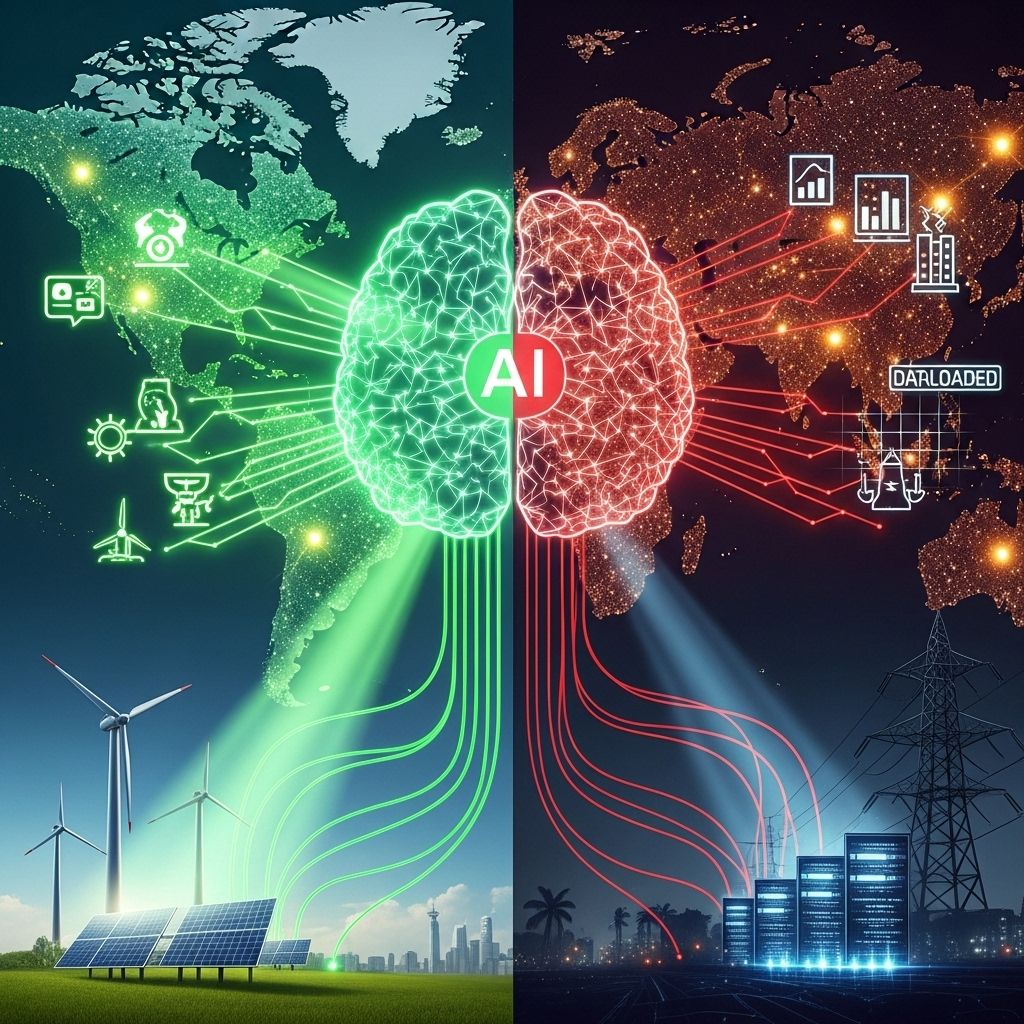
TL;DR: AI’s dual role decarbonization story in 2025 is reshaping the global energy sector. While AI accelerates efficiency gains and green innovations, it simultaneously drives huge energy demand, risking setbacks for climate targets. Here’s what investors need to know.
What Happened
The “AI dual role decarbonization” dynamic came into sharp focus in 2025 as new data from the International Energy Agency (IEA) revealed that global electricity demand from data centers—including those powering generative AI—could hit 1,000 terawatt-hours (TWh) by year-end, up 50% since 2023. Google’s 2024 Environmental Report revealed that its emissions grew 48% since 2019, driven primarily by AI training workloads. According to the World Economic Forum, AI-enabled efficiency tools helped avoid roughly 500 million metric tons of CO2 globally last year, mainly via grid optimization and demand-response in the power sector. Still, the energy required to power AI threatens to offset sector progress, as the explosion of next-generation models and applications sharply increases the demand for water, semiconductors, and renewables. As a recent BloombergNEF analysis observed, “AI’s resource appetite risks derailing decades of incremental decarbonization if grid investments and clean generation don’t keep pace.”
Why It Matters
The significance of AI’s dual impact on decarbonization is profound for the $8 trillion global energy industry and the nascent green tech sector in particular. Analysts at Morgan Stanley estimate that by 2026, AI data center energy load could rival that of mid-sized countries, putting pricing pressure on regional grids and potentially raising wholesale power prices by up to 15%. At the same time, AI-driven solutions are fueling investment in energy optimization, carbon capture, and smart manufacturing—sectors projected by Bloomberg to see double-digit compound annual growth rates through 2030. The tension highlights a critical inflection point, as policymakers and corporates recalibrate net-zero strategies to factor in AI’s expanding footprint. For more on energy sector shifts, see investment insights at ThinkInvest.
Impact on Investors
The AI dual role decarbonization trend introduces both risk and opportunity across public equities and infrastructure. Utilities (XLU), renewable energy producers (NEE, BEPC), and grid technology firms (ABB, Siemens) may benefit from surging demand and regulatory incentives for greener capacity. Conversely, companies exposed to grid bottlenecks or unsustainable AI-driven growth (notably large-cap techs like GOOGL and MSFT) could face ESG scrutiny and cost shocks. The S&P Global Clean Energy Index outperformed the broader market by 4% in Q2 2025—a trend some analysts attribute to institutional rotation favoring “AI-resilient” green plays. Investors should monitor legislation affecting energy tariffs and carbon pricing, as well as capital flows into AI infrastructure funds targeting sustainable data center buildouts. For more market analysis, visit ThinkInvest.
Expert Take
Analysts note that “balancing AI-enabled climate solutions with the technology’s ballooning energy needs is now a central challenge for both energy markets and sustainability investors,” according to HSBC’s head of energy transition research. Market strategists suggest the winners will be firms that “can harness AI’s power while aggressively decarbonizing their own operations.” For background on data center trends, visit trend reports on energy investment.
The Bottom Line
AI’s dual role decarbonization narrative will define market opportunities and regulatory debates in 2025. Investors who track both the innovation upside and grid risk spectrum will be best placed to navigate the coming energy transition. As the sector rebalances, identifying companies that turn AI efficiency into measurable emissions reductions will be key.
Tags: AI, decarbonization, energy sector, data centers, green technology.




