

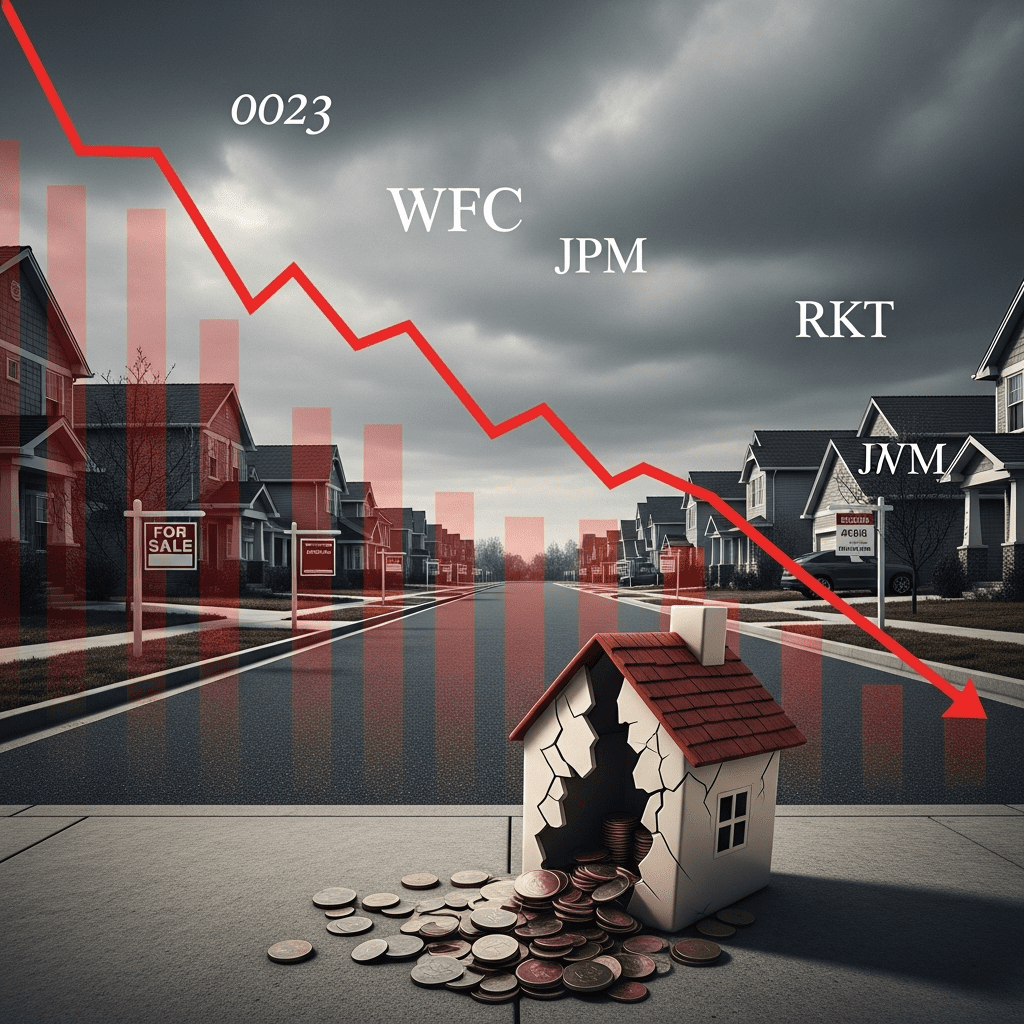
Mortgage originations in the U.S. fell to $1.45 trillion in Q3 2025 as Wells Fargo ($WFC) and JPMorgan Chase ($JPM) each reported double-digit declines. America’s huge mortgage market is slowly dying, upending banks, bond markets, and housing demand as rates soar past 7%. Analysts are shocked at the rapid erosion of activity.
Mortgage Originations Plunge to Multi-Year Lows in 2025
The U.S. mortgage market, once the cornerstone of household wealth and consumer credit, continues to contract sharply. In Q3 2025, total mortgage originations fell to $1.45 trillion—down 18% from $1.77 trillion a year earlier and 42% below the $2.55 trillion peak in 2021, according to Mortgage Bankers Association (MBA) and Federal Reserve data.
Major originators are feeling the pain. Wells Fargo ($WFC), long the largest mortgage lender, posted a 24% year-over-year decline in new home loans in its October 2025 filing. JPMorgan Chase ($JPM) reported a 21% drop, and Rocket Companies ($RKT), the fintech lender, saw origination volumes halve from 2022 levels.
Mortgage rates, which climbed above 7.1% for a 30-year fixed-rate loan in November 2025 according to Freddie Mac, have frozen would-be buyers and effectively killed off refinancing activity—now 80% below its 2021 level. According to Bloomberg, purchase applications remain down 36% from pre-pandemic levels, and the Mortgage Credit Availability Index, a proxy for lending standards, sits at its tightest since 2013.
“Volume is down across the board—refi, purchase, everything,” said MBA Chief Economist Mike Fratantoni in an October 2025 interview with Reuters. “We have not seen a downturn of this magnitude since the housing bust of 2008.”
Shrinking Mortgage Market Reshapes U.S. Housing and Economy
The contraction of America’s huge mortgage market is rippling through the U.S. financial system and real estate sector. Home sales have tumbled in both new and existing segments: the National Association of Realtors reported just 3.8 million existing home sales on an annualized basis in October 2025, the lowest since 1995.
Inventory remains tight—total listings hovered near 1.1 million, still well below the 2.0 million average from 2017-2019—but the real squeeze is on affordability. With the average monthly payment for a new mortgage now above $2,800, according to Redfin, the pool of able buyers is shrinking.
The slump is also pressuring banks and mortgage REITs. Wells Fargo ($WFC) and Bank of America ($BAC) have slashed their mortgage staffs by over 30% since 2022. Mortgage-backed securities (MBS) issuance tracked by the Securities Industry and Financial Markets Association is down 44% from its peak, while Agency MBS spreads have widened, making funding more expensive for lenders.
Consumer resilience is showing cracks: Mortgage delinquencies rose to 2.15% in Q3 2025, up from 1.7% a year ago (MBA), and early-stage delinquencies (30-59 days) have surged nearly 30%. While outright foreclosures remain subdued due to conservative post-crisis lending, the rise in late payments is a key red flag for risk managers and bond investors.
Meanwhile, homebuilder stocks like D.R. Horton ($DHI) and Lennar ($LEN) have outperformed broader housing indices, bolstered by new-home demand from cash buyers and corporate landlords such as Invitation Homes ($INVH). However, most analysts expect this support may not last if rates remain high and consumer stress intensifies.
Investor Strategies Shift as Mortgage Market Contracts
For investors, the slow unraveling of America’s huge mortgage market calls for vigilance and adaptability. Direct exposure to mortgage lenders and servicers carries heightened risks: Non-bank lenders like Rocket Companies ($RKT) and UWM Holdings ($UWMC) face margin compression, rising delinquencies, and volatile funding spreads.
Meanwhile, bank stocks with sizable mortgage units, including JPMorgan Chase ($JPM) and Wells Fargo ($WFC), are recalibrating their business models toward fee income, wealth management, and credit cards. Mortgage REITs that rely on leverage to juice returns from MBS—such as Annaly Capital ($NLY)—have seen dividend yields spike to over 14%, but investors should beware the risk of book value erosion and forced asset sales.
Fixed-income portfolios have also evolved. With MBS issuance falling, yields on new Agency MBS (Fannie/Freddie) have widened to over 6.2%, a level last seen in 2007. Yet prepayment risk is diminished, while credit concerns linger for non-agency securitizations, especially those exposed to subprime borrowers.
A pivot toward alternative real estate, short-duration bonds, or even select housing tech stocks could offer diversification. Investors tracking stock market analysis for U.S. banks or top financial news can capture updated views on sector rotation and credit risk.
Cash-rich buyers, including institutional investors and private equity, are seizing select distressed mortgage portfolios, but deal volume remains well below prior cycles. For retail investors, maintaining a balanced allocation and scrutinizing credit exposures are key as macro headwinds persist.
Analysts Warn of Prolonged Weakness in Mortgage Lending
Experts remain cautious about a near-term rebound in America’s huge mortgage market. Goldman Sachs Research, in its August 2025 U.S. housing outlook, projected full-year originations will total just $1.8 trillion, the lowest since 2014, with only a modest recovery likely if rates fall below 6% next year.
Several market strategists note that the Federal Reserve’s approach remains a central variable. Despite signals of a potential rate pause in late 2025, Chair Jerome Powell reaffirmed the Fed’s commitment to hold rates elevated until inflation stabilizes—a stance echoed in FOMC minutes from September 2025. Mortgage demand may remain muted even as unemployment edges higher (4.3% in latest BLS data; Reuters), given persistent unaffordability.
Affordability challenges are unlikely to abate soon. A Moody’s Analytics report from October 2025 estimates that 73% of U.S. counties remain unaffordable for the median-income family, a sharp jump from 58% in 2019. Analysts also flag emerging risks in commercial real estate and suggest that mortgage market disruptions could spill into other risk assets, especially if lending tightens further.
Still, some positive signals remain: household leverage is at post-GFC lows, and most CRE risk is remote from residential MBS. As one S&P Global note observed in September, “The market is orderly, not panicked—but what’s dying is the once-endless pipeline of new lending.”
What America’s Huge Mortgage Market’s Decline Means for Investors
Looking ahead, the steady contraction of America’s huge mortgage market points to an era of tighter credit, lower loan volumes, and greater scrutiny of lending risks. Investors should expect further margin pressure on lenders and servicers, stalling MBS issuance, and a persistent affordability squeeze in housing.
For active investors, rigorous due diligence on mortgage-heavy financials, steady monitoring of bond market spreads, and adaptive rotation toward less rate-sensitive assets will be crucial. The sector’s slow unraveling may also create episodic volatility—and opportunity—for those tracking U.S. bank stocks or seeking insight from up-to-date economic research.
The key takeaway: while America’s huge mortgage market is slowly dying, it remains a vital barometer for economic stress—and a key guide for forward-looking investment strategies in 2025 and beyond.
Tags: mortgage market, housing crisis, MBS, interest rates, macroeconomy




