

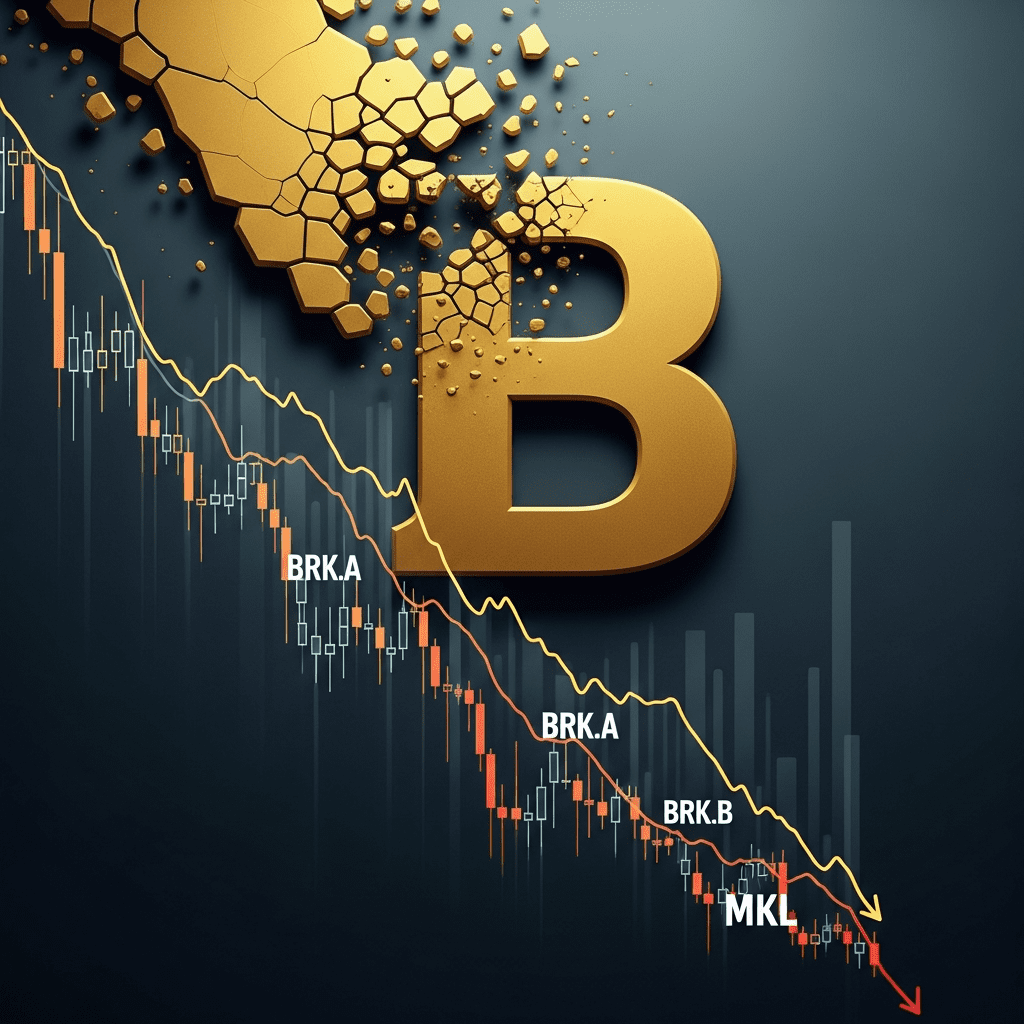
Berkshire Hathaway ($BRK.A) shares shed $65 billion in market cap after board members revealed Warren Buffett’s succession plan, raising urgent questions about the future of the ‘Buffett Premium.’ The abrupt announcement startled investors expecting stability. Is the era of the Buffett Premium finally over?
Berkshire Loses $65B as Succession Plan Raises Buffett Premium Doubts
Berkshire Hathaway ($BRK.A) shares declined 6.1% to $492,750 by the close of November 3, erasing more than $65 billion in market value, according to Bloomberg data. The drop followed the company’s official confirmation earlier today that Vice Chairman Greg Abel will succeed Warren Buffett, age 95, as CEO. Trading volumes spiked to 780,000 shares, nearly double the three-month daily average. The sudden transition unnerved market participants accustomed to Buffett’s steady leadership, with some analysts noting the company’s Class B shares ($BRK.B) mirrored the Class A drop, falling to $327.79 from $349.13 at the open. Berkshire’s board stressed that continuity across core investing divisions would remain intact, but the market’s reaction underscored deep skepticism over whether the famed Buffett Premium is sustainable without its namesake at the helm (Bloomberg).
How Berkshire’s Leadership Change Impacts Value Investing Sector
The sharp reaction from Berkshire shareholders sparked a broader debate across the value investing sector. Firms that historically benefited from association with Buffett’s investment philosophy saw ripple effects: shares of Markel ($MKL), often dubbed “a baby Berkshire,” slid 4.5% to $1,295, while the S&P 500 Value Index retreated 1.2% on the day, lagging the broader S&P 500’s 0.5% decline (Reuters, November 3, 2025). Value-focused fund outflows accelerated, with preliminary Morningstar data indicating net withdrawals of $2.1 billion from value ETFs in the immediate aftermath. Market observers drew historical comparisons to 2006’s transition at Legg Mason, where a leadership shakeup precipitated multi-year underperformance. The scale of Berkshire’s brand association with Buffett—often estimated to contribute a 10%-15% valuation uplift—now appears at risk, potentially changing the calculus for institutional allocators across the value sector.
How Investors Can Navigate Berkshire’s Post-Succession Shift
Investors recalibrating their portfolios in light of Berkshire Hathaway’s ($BRK.A, $BRK.B) leadership transition face heightened uncertainty and possible volatility. For long-term holders, some analysts at Morgan Stanley suggest focusing on the company’s strong underlying businesses—insurance, utilities, and rail—over the so-called Buffett Premium embedded in the share price. Active traders may find short-term opportunities in elevated volatility, as options volume for $BRK.B surged 220% above average in afternoon trading. Diversified investors might consider balancing exposure across the value sector, as correlated stocks like Markel ($MKL) and Loews Corporation ($L) came under pressure. For data-driven portfolio moves and evolving stock market analysis, monitoring Berkshire’s upcoming annual letter could provide further clues, while the latest financial news highlights additional macro catalysts affecting the sector.
What Analysts Expect for Berkshire and the Value Investing Landscape
Industry analysts observe that investor sentiment toward Berkshire Hathaway may remain fragile in coming quarters, given the outsize influence of Warren Buffett’s reputation on company valuation. According to consensus compiled by FactSet as of October 2025, price targets for $BRK.B have been revised downward by 8% since September, reflecting market uncertainty. Investment strategists note that sustained outperformance will hinge on Greg Abel’s ability to reinforce Berkshire’s decentralized culture and deliver disciplined capital allocation without Buffett’s celebrated intuition.
Buffett Premium Succession Impact Signals New Market Era in 2025
The market’s reaction to Berkshire’s succession plan cements the Buffett Premium succession impact as a defining moment for value investing. With $65 billion in market cap erased and volatility likely to persist, investors should closely watch Berkshire’s quarterly disclosures and sector rebalancing flows. This historic transition signals a new era—requiring focus on fundamentals over legendary leadership as the value sector adapts.
Tags: Berkshire Hathaway, BRK.A, Buffett Premium, stock market analysis, value investing




