





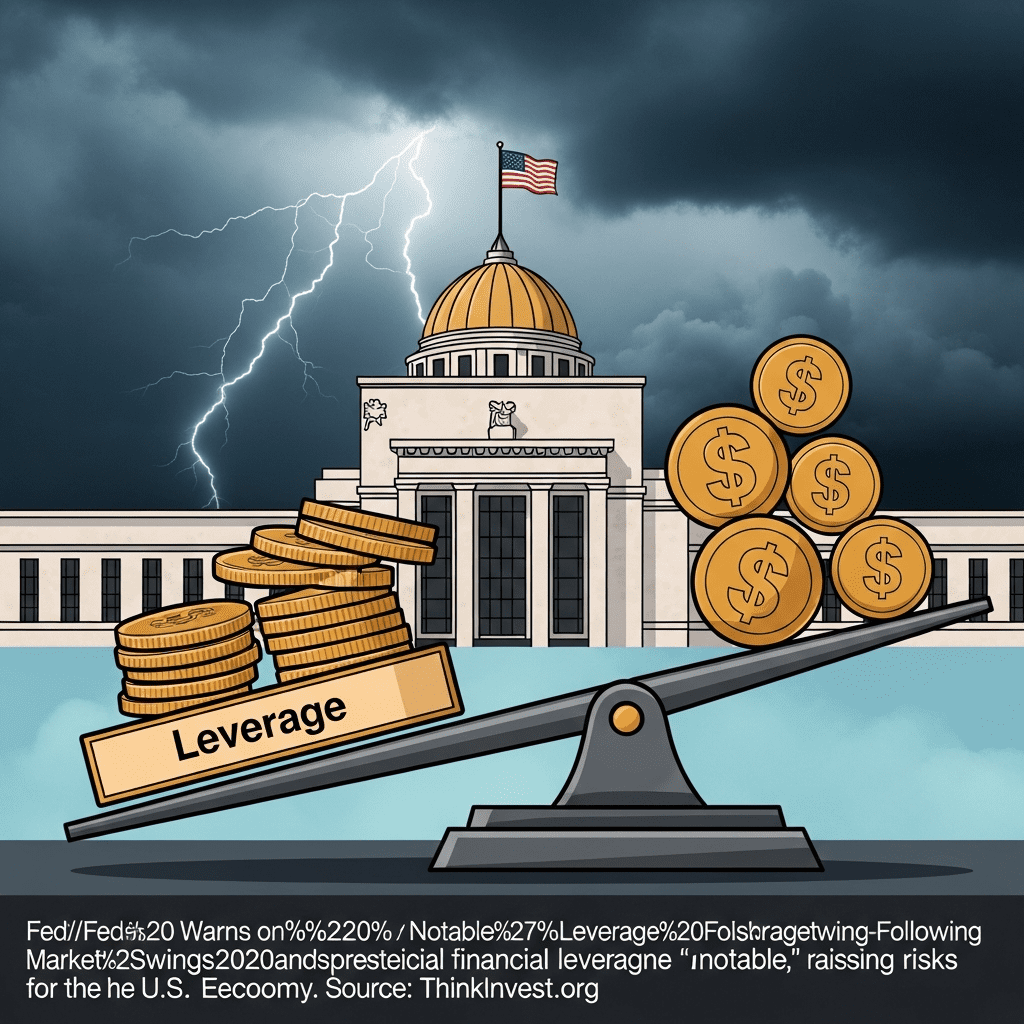
The Federal Reserve ($FED) revealed that vulnerabilities tied to financial leverage have become “notable,” surprising investors amid ongoing market volatility. The Fed says vulnerabilities linked to financial leverage now pose broader risks for the U.S. economy, prompting new scrutiny over hedge funds and nonbanks. Are markets underestimating the impact of rising leverage?
Fed Warns on ‘Notable’ Leverage Risks Following 2025 Market Swings
The Federal Reserve disclosed in its latest Financial Stability Report, released on November 7, 2025, that financial leverage across investment funds and other nonbank entities has reached levels warranting “notable” concern. Aggregate hedge fund leverage ratios increased to 2.8x net assets in Q3 2025, up from 2.4x in Q1, according to the Office of Financial Research data.[1] The Fed’s report highlighted particular risks in the private credit and commercial real estate segments, where outstanding leveraged loans climbed 9% year-to-date to $1.44 trillion per S&P Global data.[2] Meanwhile, equity market volatility, as measured by the CBOE VIX Index, surged above 26 for the first time since March 2023, amplifying the potential market impact if concentrated leverage were to unwind abruptly.[3]
Why Rising Leverage Prompts Sector-Wide Caution for Investors
The escalation in financial leverage signals shifting dynamics across both traditional and alternative investment sectors. As nonbank financial institutions now account for nearly 54% of total U.S. financial system assets, per the Financial Stability Board’s 2024 Global Monitoring Report, their activities directly influence liquidity and credit cycles.[4] Sectors such as commercial real estate and high-yield corporate debt remain most exposed: commercial mortgage-backed securities saw delinquency rates jump from 2.1% to 3.6% over the past twelve months, while corporate bond spreads have widened by 48 basis points since July 2025, Bloomberg data shows. These trends suggest that leverage-fueled gains in recent quarters may reverse sharply if asset prices or funding availability deteriorate. Policy shifts—including tighter lending standards by major U.S. banks in the October 2025 Fed Senior Loan Officer Survey—add another layer of risk to leveraged sectors, increasing the likelihood of forced asset sales or market contagion.
How Investors Should Navigate Fed Leverage Warning Now
Investors face new challenges in managing exposure to leveraged sectors as the Fed says vulnerabilities tied to financial leverage are no longer contained. Portfolio managers are reviewing allocations in riskier asset classes, such as private credit funds, leveraged loans, and nonbank-issued structured products. Diversification into higher-quality, liquid assets—like short-duration Treasuries and investment grade corporates—has picked up, with Bank of America reporting $38 billion in inflows into U.S. Treasury ETFs from August through October 2025.[5] Traders holding positions in firms exposed to credit cycles, such as Blackstone Inc. ($BX) and KKR & Co. Inc. ($KKR), should closely monitor quarterly disclosures for leverage metrics. For ongoing market analysis and actionable strategies, see stock market analysis and the latest financial news on ThinkInvest.org. Meanwhile, long-term investors are advised to track upcoming Fed policy updates and shifting regulatory guidance targeting nonbank leverage concentrations.
What Analysts Expect Next for U.S. Markets Amid Leverage Concerns
Market consensus suggests that the elevated focus on leverage will drive both increased regulatory scrutiny and higher market volatility into early 2026. According to analysts at JPMorgan and Goldman Sachs, liquidity in leveraged loan markets has diminished by nearly 15% since June 2025, raising the specter of sudden dislocations if macro conditions worsen. Industry analysts observe that risk premiums for credit, real estate, and alternative asset classes are likely to remain elevated as uncertainty over Fed policy and market leverage persists.
Fed Says Vulnerabilities Financial Leverage Signal Caution for 2025
The Fed says vulnerabilities tied to financial leverage indicate a pivotal moment for investors as 2025 draws to a close. With leveraged market segments signaling heightened risk, participants should closely monitor Fed communications, liquidity conditions, and macro developments. Active portfolio risk management and sector rotation will be crucial as leverage vulnerabilities shape market direction in coming quarters.
Tags: Fed, leverage, financial-stability, nonbanks, risk-management