

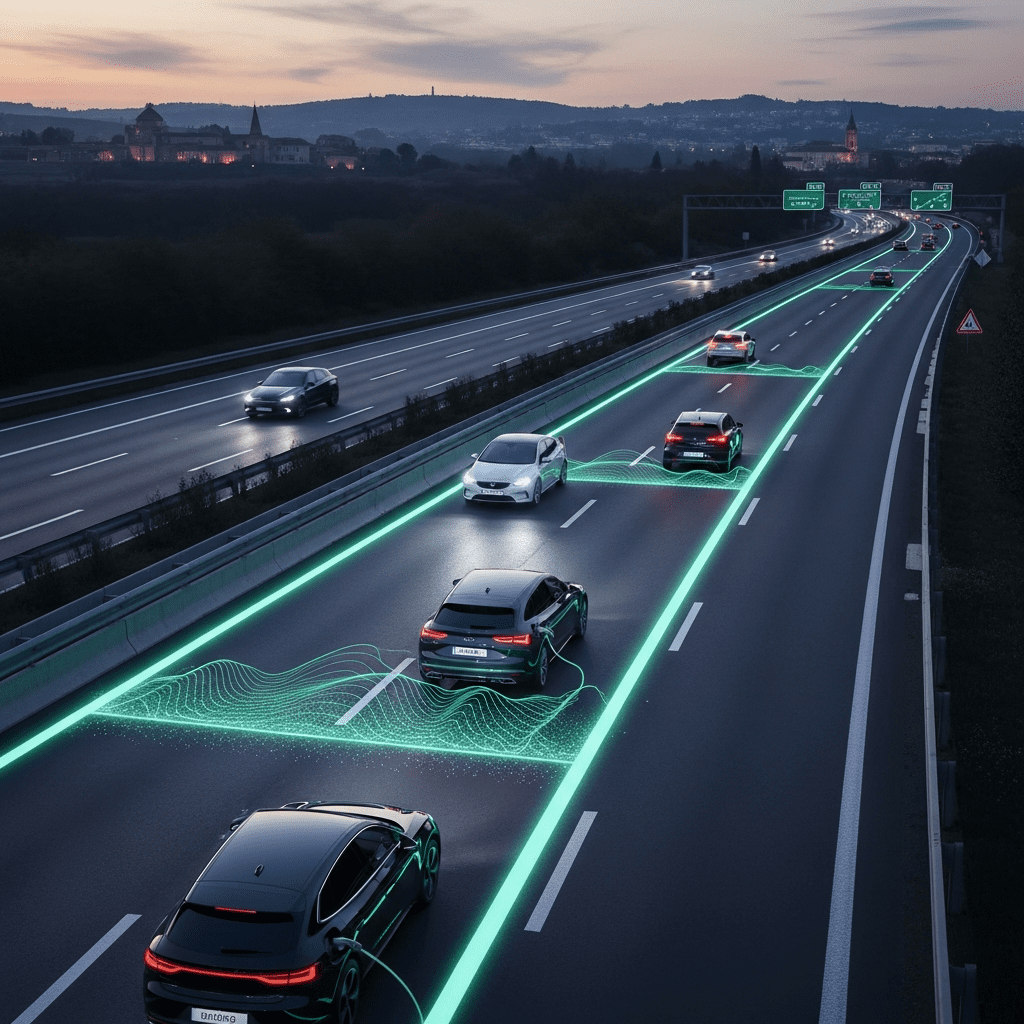
Vinci Autoroutes ($VINCI) unveiled a French highway segment capable of delivering wireless EV charging at up to 250 kW, eclipsing Tesla’s ($TSLA) Supercharger network and challenging traditional charging models. This breakthrough in French highway wireless EV charging defies expectations over range anxiety and infrastructure speed.
French Highway Installs 2 km of 250 kW Wireless Charging Lanes
On November 8, Vinci Autoroutes ($VINCI) announced the activation of Europe’s first public highway segment equipped for high-speed wireless EV charging. The 2-kilometer section, located on the A10 near Tours, uses ElectReon’s induction technology to deliver up to 250 kW of power directly to vehicles in motion. Early tests demonstrated compatible EVs recharged at nearly 20 kilometers of range per minute—outpacing the 150–250 kW output of most Tesla ($TSLA) V4 Superchargers in France as of October 2025 (source: Les Echos, ElectReon press release, October 2025). The project’s €35 million ($37M) investment comes as battery EV registrations in France rose 27% year-over-year to 256,900 units in January–September 2025, according to the Comité des Constructeurs Français d’Automobiles (CCFA).
Wireless EV Highway Charging Signals Major Shift in Infrastructure Trends
This highway innovation marks a potential inflection point for European clean transport. Traditional charging stations face bottlenecks: the EU counts over 630,000 public plugs (ACEA August 2025), but over 60% are slow (22 kW or less) and concentrated in just four countries. By embedding high-speed wireless charging in existing highways, France may accelerate EV adoption while easing pressure on the national grid and fast-charger buildout. BloombergNEF noted in June 2025 that battery cost declines and infrastructure advances are critical to Europe meeting its goal of 100% zero-emission vehicle sales by 2035. The move puts pressure on automakers and energy utilities to include dynamic wireless charging readiness in their long-term plans.
How Investors Can Capitalize on Wireless EV Charging Disruption
Investors positioned in infrastructure specialists and advanced mobility firms stand to benefit as wireless EV charging gains traction. Vinci Autoroutes ($VINCI), ElectReon ($ELRN.TA), and key construction partners could see new revenue streams—and broader market re-rating—if this pilot expands nationwide. Automakers like Renault ($RNO.PA) and Peugeot ($STLA) with early adoption strategies may gain competitive edge. Sector-focused ETFs exposed to clean transport and renewables may also see positive flows. As with all emerging tech, regulatory hurdles and technology standardization remain risks. Investors tracking stock market analysis and latest financial news should monitor polices on grid integration and highway retrofits, as well as evolving partnerships between chargepoint operators and infrastructure giants.
Expert Outlook: Analysts Forecast Acceleration in Dynamic Charging
Industry analysts observe that dynamic charging—where vehicles recharge while moving—could significantly expand effective EV range and market share, particularly in logistics, ride-hailing, and commercial fleets. According to a June 2025 McKinsey report, dynamic wireless charging on highways has the potential to reduce required battery sizes by 30–50%, slashing both vehicle costs and weight. Market consensus suggests further adoption, contingent upon government incentives and cross-border standardization efforts within the EU.
What French Highway Wireless EV Charging Means for Investors in 2025
The debut of French highway wireless EV charging signals a paradigm shift in EV infrastructure, with real potential to outpace existing fast-charging networks. Investors should watch upcoming regulatory decisions, pilot results, and adoption by OEMs as this technology matures and scales. Staying alert to the French highway wireless EV charging trend could unlock long-term portfolio advantages as the mobility landscape evolves.
Tags: EV charging, TSLA, VINCI, wireless technology, infrastructure




