

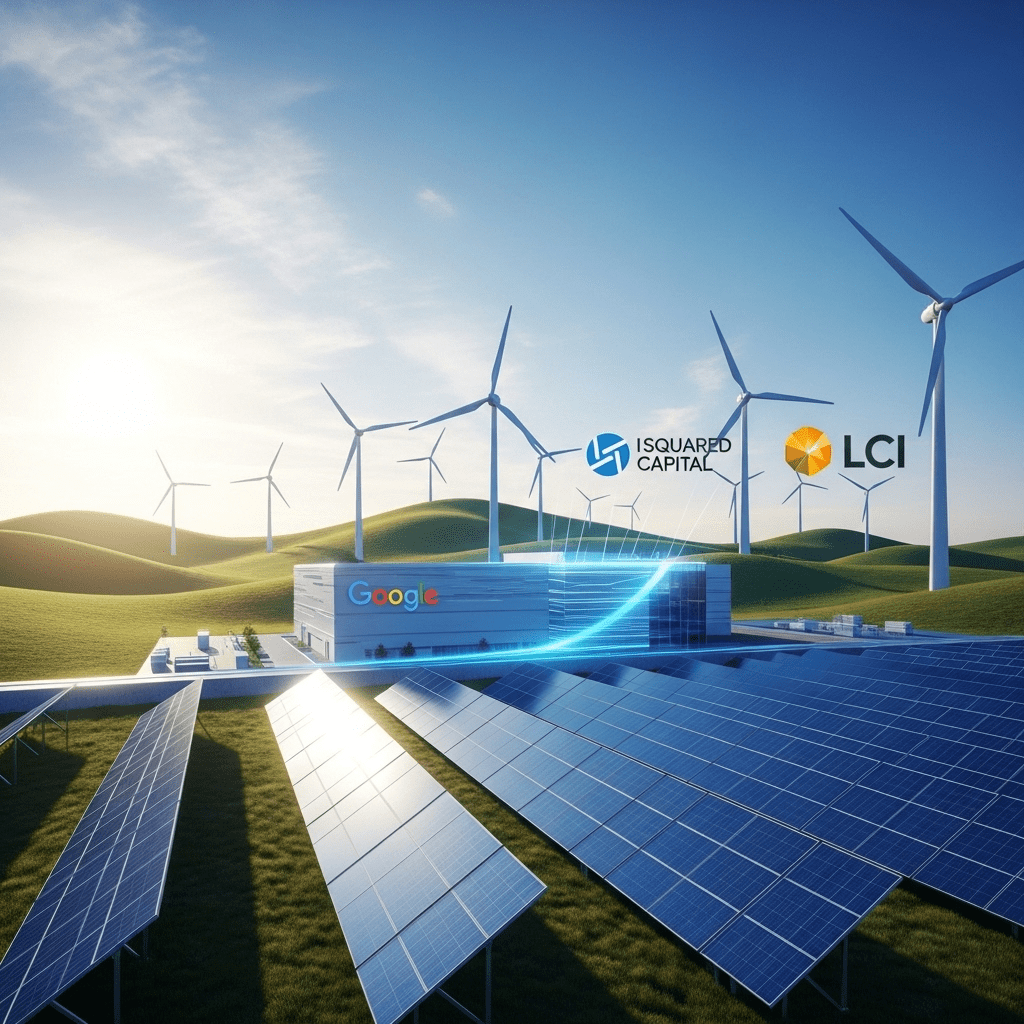
The I Squared and LCI clean power partnership with Google marks a major advance in corporate renewable energy adoption. This collaboration not only deepens Google’s clean energy commitments but also represents strategic investment opportunities in the global transition to sustainable power.
What Happened
On June 4, 2025, I Squared Capital and LCI, an international infrastructure investor and leading clean energy developer, announced a landmark agreement to provide renewable electricity to Google’s European data centers. The I Squared and LCI clean power partnership with Google includes long-term power purchase agreements (PPAs) spanning more than 800 megawatts (MW) of new wind and solar generation capacity across Ireland, Germany, and the Nordics, according to a joint press release and coverage by Reuters. Under the deal, LCI will finance, develop, and operate the renewable assets, while Google commits to buying the generated clean power to support its 2030 full decarbonization targets.
“As demand for digital infrastructure intensifies, we are aggressively scaling our clean energy footprint to match both customer needs and our own sustainability goals,” said Maud Texier, Google’s Global Head of Energy Development, in the statement. The deal is part of Google’s ongoing commitment to operate all its cloud regions and data centers on 24/7 carbon-free energy by 2030.
Why It Matters
This partnership is significant for several reasons. First, it demonstrates tech giants’ continued push toward decarbonization—even as data center power needs are set to more than double by 2030, propelled by the rise of AI and cloud computing (BloombergNEF projection, April 2025). Google’s move also puts competitive pressure on peers like Microsoft and Amazon, who are similarly ramping up renewable energy procurement. For the global renewables industry, “anchor” corporate off-takers like Google provide critical demand signals that help unlock financing for large-scale wind and solar projects—especially in regions with slower grid renewables adoption or permitting bottlenecks.
From a macro perspective, the I Squared and LCI clean power partnership with Google illustrates how infrastructure funds and private equity are becoming pivotal in closing the global clean energy investment gap. According to the International Energy Agency (IEA), annual global investment in renewable power needs to reach $1.3 trillion by 2030—significantly higher than current levels. Partnerships like this can accelerate progress.
Impact on Investors
The announcement spotlights actionable trends for investors in infrastructure (IGF), renewables (ICLN), and data center REITs (EQIX, DLR). As demand for decarbonized digital infrastructure soars, companies enabling low-carbon cloud computing and energy transition are poised for growth. Private equity firms like I Squared strengthen their asset pipelines and exit options via corporate PPAs, while utilities and independent power producers (IPPs) benefit from stable offtake agreements.
Notably, European grid operators may see upside as new wind and solar projects come online. Risks include permitting delays and regulatory changes, especially amid evolving definitions of 24/7 carbon-free energy. “Investors should monitor for policy volatility across European energy markets, but long-term corporate PPAs are lowering counterparty risk,” said Laura Hughes, ESG analyst at Ardea Partners.
For additional context on sustainable investment themes, see ThinkInvest’s investment insights and market analysis.
Expert Take
Analysts note that Google’s proactive procurement could set a new bar for sustainability in the digital sector. Market strategists suggest this partnership will catalyze further cross-sector deals, deepening the integration of private capital into the clean energy value chain.
The Bottom Line
The I Squared and LCI clean power partnership with Google highlights the critical role of innovative financing and corporate commitment in accelerating Europe’s clean energy transition. For investors, the deal signals growing opportunities—and competition—across renewable infrastructure, energy markets, and sustainability-linked assets as corporate demand for decarbonized power intensifies through 2030 and beyond.
Tags: clean energy, Google, renewable infrastructure, power purchase agreements, private equity




