

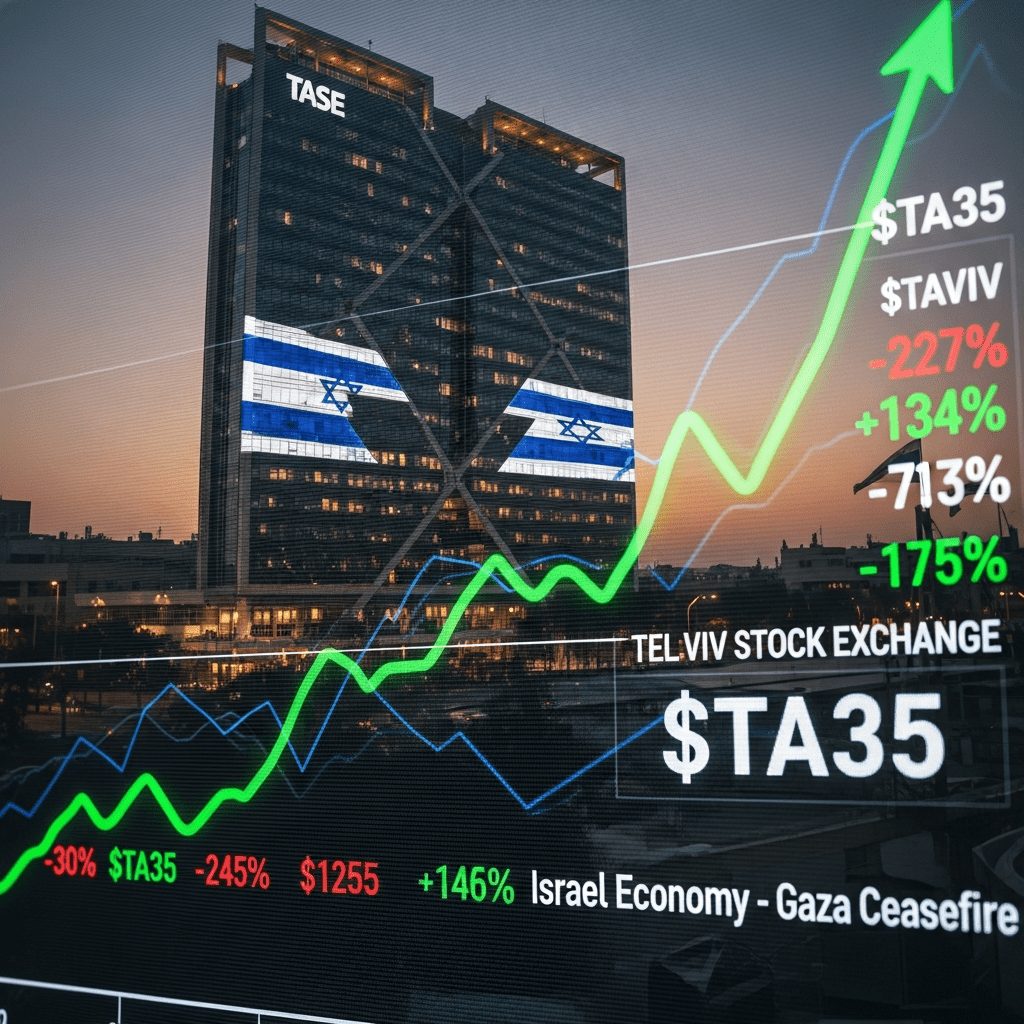
Israel’s benchmark TA-35 index ($TA35) jumped 6.2% in November as the Israel economy rebound Gaza ceasefire narrative gained traction. GDP surged an unexpectedly strong 4.8% annualized in Q3 2025, surprising analysts and lifting market sentiment across regional equities. What drove this rapid turnaround ahead of the anticipated ceasefire?
Israel GDP Grows 4.8% as TA-35 Index Climbs 6.2% in November
Israel’s economy defied expectations by posting a 4.8% annualized GDP expansion in Q3 2025, according to preliminary data released by Israel’s Central Bureau of Statistics on November 10. The TA-35 index ($TA35), representing the primary blue-chip stocks on the Tel Aviv Stock Exchange, rallied 6.2% during the first two weeks of November, closing at 2,210.44 on November 15. Trading volumes spiked to their highest since January 2024, with over 1.3 billion shares exchanged in just five sessions, per Bloomberg data. The shekel strengthened 3.1% against the US dollar during the period, reflecting renewed investor confidence.
Why Regional Markets Reacted to Israel’s Surprise Recovery
Israel’s economic resurgence rippled through regional equities, with the broader MSCI Israel Index rising 5.7% since October 25, outpacing emerging market peers. This rebound comes after a sharp contraction in Q4 2023, when GDP shrank 1.8% amid initial conflict escalation. Improved export figures and robust tech sector growth underpinned the recovery; Bank of Israel reported a 9.4% increase in tech exports year-over-year as of September 2025. Energy shares, such as Delek Group ($DLEKG.TA), soared alongside global oil stability. These trends signal resilience and adaptability across Israel’s key economic sectors, driven by expectations of a truce and normalizing cross-border trade. Broader Middle East ETFs, tracked by large institutions, also showed positive momentum after months of outflows.
How Investors Are Shifting Portfolios Ahead of Gaza Ceasefire
Investors are recalibrating portfolios to capture Israel’s recovery, facing both upside and risks from event-driven volatility. Sector-specific allocations—particularly in technology, energy, and financials—have seen net inflows, per data from EPFR Global. International funds increased exposure to blue-chip Israeli companies like Bank Leumi ($LUMI.TA) and NICE Ltd. ($NICE) following the Q3 GDP beat. Fixed income investors rotated out of safe-haven government bonds, with 10-year yield spreads narrowing by 31 basis points in early November, according to Reuters. Active traders monitoring stock market analysis have seized opportunities for tactical gains, while some strategists recommend vigilance ahead of upcoming Knesset fiscal votes. For broader context, investors exploring latest financial news are tracking sectoral and currency impacts across the region.
What Market Analysts Predict for Israel’s Economic Recovery
Industry analysts observe that Israel’s unexpectedly strong rebound is supported by both pent-up demand and resilient export sectors. Morgan Stanley analysts, in a late October 2025 commentary, highlighted supportive monetary policy and improving geopolitical outlook as tailwinds for local equities. Market consensus suggests the pace of gains may moderate if ceasefire negotiations stall, but ongoing capital inflows point to sustained investor confidence in Israel’s fundamentals. Analysts are also watching fiscal developments and corporate earnings for confirmation of the recovery trend.
Israel Economy Rebound Gaza Ceasefire Signals Regional Shift in 2025
The Israel economy rebound Gaza ceasefire theme signals a new phase for regional investors as normalization prospects drive renewed optimism. Market participants should monitor ongoing negotiations and economic data releases for early signals of further upside—or risk. For those watching the intersection of geopolitics and market performance, Israel’s trajectory remains a bellwether for emerging market resilience in late 2025.
Tags: Israel economy, TA-35, Gaza ceasefire, emerging markets, GDP growth




