

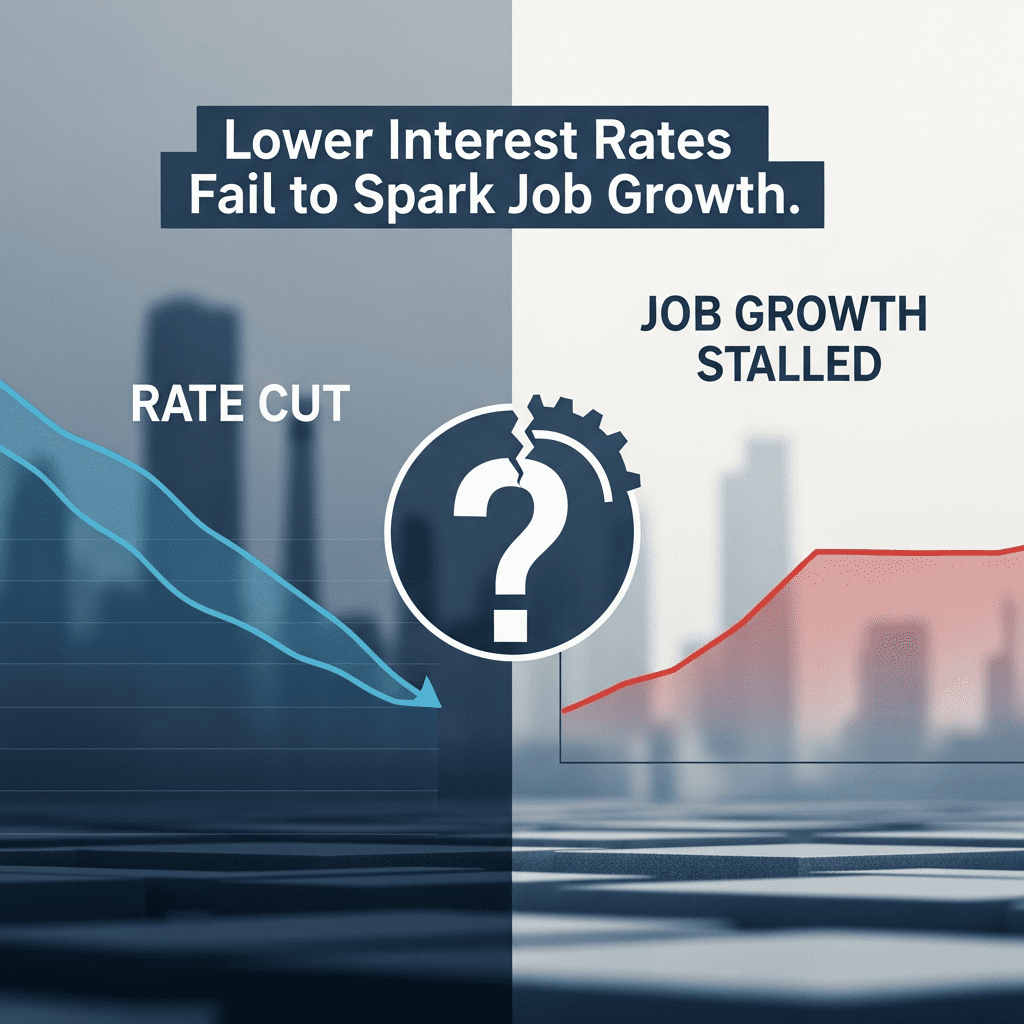
Federal Reserve policymakers revealed job growth stalled despite the latest rate cut, challenging assumptions that lowering interest rates would rejuvenate America’s employment market. Latest figures from the Labor Department ($FED) spotlight the puzzling disconnect fueling analyst debate around the lower interest rates job market dilemma.
Fed’s Latest Rate Cut Fails to Boost U.S. Job Creation in Q4
On November 7, 2025, the Federal Reserve ($FED) reduced its benchmark federal funds rate by 25 basis points to 4.75%, its lowest level since June 2022. Yet, October’s nonfarm payroll data show job additions lagged at just 102,000—down sharply from the 187,000 average monthly gain recorded across Q3 2025, according to the U.S. Bureau of Labor Statistics (BLS). The national unemployment rate remains elevated at 4.2%, up from a 3.8% reading in April. Markets have responded with caution: the S&P 500 ($SPX) posted a muted +0.5% weekly gain after the cut, per Bloomberg closing data, as investors await further labor market clarity.
Why Labor Market Trends Defy Conventional Policy Expectations
Historically, declining interest rates triggered corporate borrowing and job expansion. However, this cycle reveals stark deviations. The National Federation of Independent Business (NFIB) reports only 17% of small firms planned to hire in October—down from 25% a year earlier. Persistent productivity gains in sectors such as manufacturing and logistics, where robot installations rose by 12% year-over-year (International Federation of Robotics), have displaced the need for labor even as borrowing costs fall. Furthermore, labor force participation remains subdued at 61.7%, well below its pre-pandemic level of 63.4% (BLS, November 2025), underscoring demographic headwinds and skill mismatches shaping workforce dynamics.
How Investors Can Navigate the Rate Cut and Job Market Disconnect
Investors seeking stability in this disjointed environment should consider diversification beyond traditional cyclical plays. Sectors with resilient profit margins, such as healthcare (S&P 500 Health Care Index: +4.1% year-to-date) and technology platforms automating workforces, have outperformed lagging industrials and retail stocks. Meanwhile, reduced labor demand weighs on consumer sentiment, potentially impacting discretionary spending and consumer-facing equities. Latest financial news coverage highlights that fixed-income assets may see limited gains unless job market momentum returns. For ongoing policy analysis, visit investment strategy discussions tracking both job and rate announcements. Investors should also monitor companies reporting tighter hiring plans, as slow payroll growth may limit broad equity rallies seen in prior easing cycles.
What Analysts Expect Next for Labor and Equity Markets
Market consensus suggests further rate cuts may do little to stimulate robust job creation in the short term. According to analysts at Goldman Sachs and Morgan Stanley, ongoing automation and demographic shifts will likely continue suppressing labor demand through early 2026. Industry observers emphasize that only significant upskilling investment or policy intervention could meaningfully boost hiring, leaving current monetary tools with limited effectiveness in breaking the employment logjam.
Lower Interest Rates Job Market Trend Signals New Risks for 2025
Persistent weakness in the lower interest rates job market highlights structural employment shifts that standard monetary policy cannot quickly remedy. Investors should watch for signals of labor demand stabilization and sector rotation as the U.S. navigates economic uncertainty. Selective positioning and vigilance remain crucial as employment data, rather than rate cuts alone, will likely dictate market tone into 2026.
Tags: lower interest rates, job market, Federal Reserve, unemployment, economic policy




