

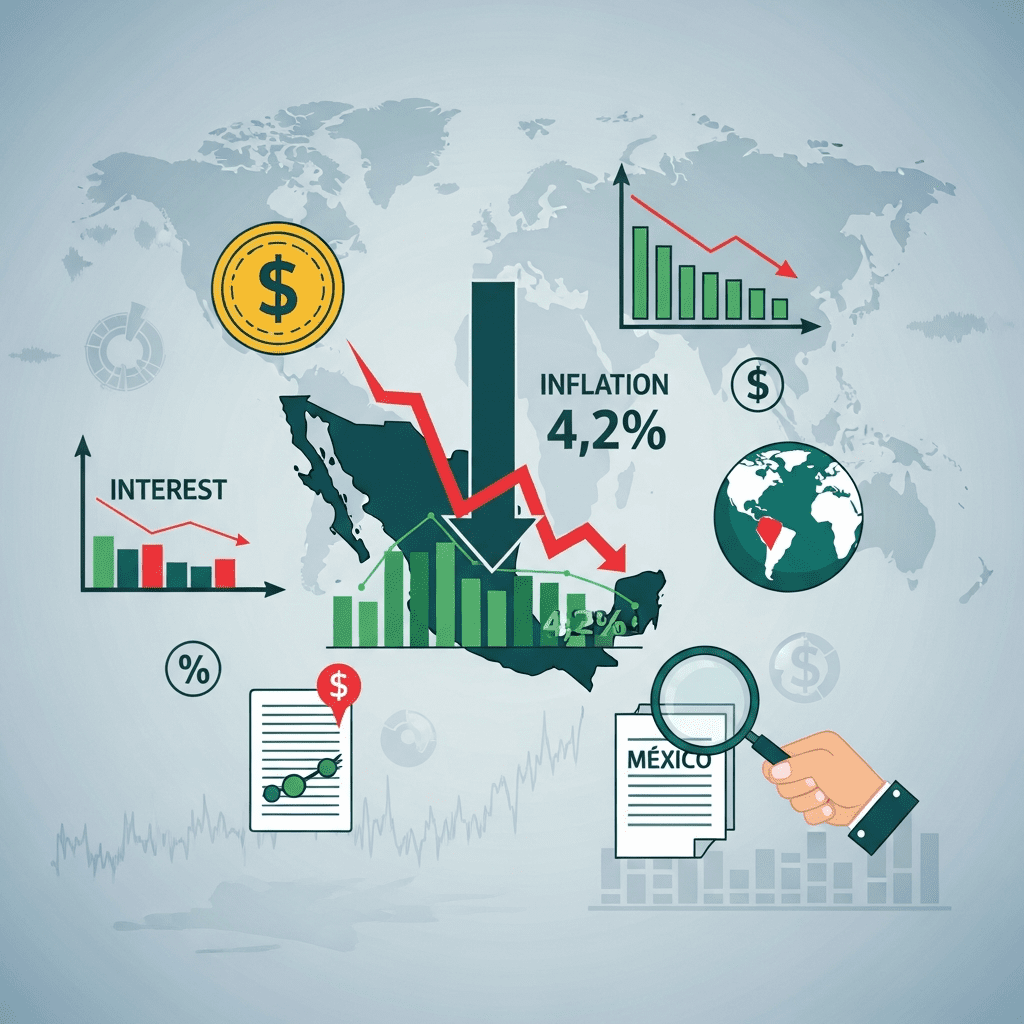
Mexico’s central bank ($BANXICO) revealed October inflation slowed to 4.2%, catching analysts off guard after its recent rate cut. The Mexico inflation October 2025 trend now signals a changing path for monetary policy and investor outlook. Are markets underestimating the impact of Banxico’s easing?
Mexico Inflation Falls to 4.2% in October After 25 Basis Point Cut
Headline inflation in Mexico slipped to 4.2% year-over-year in October 2025, down from 4.4% in September, according to data from the National Institute of Statistics and Geography (INEGI) published on November 7. The slowdown followed Banco de México’s ($BANXICO) 25 basis point rate cut on October 19, taking the benchmark policy rate to 10.75%—its first reduction since 2021. Core inflation, which strips out volatile food and energy prices, also eased to 4.1% from 4.3% the previous month. This decline marks the lowest annual inflation rate since June 2021, outpacing market expectations—a Reuters poll of economists anticipated just a 0.1 percentage point drop to 4.3%.
Why Banxico’s Rate Cut Shifted Expectations for Emerging Markets
The central bank’s decision to cut rates signals confidence that Mexico’s recent inflation spike is easing. Throughout 2022 and 2023, Banxico pursued one of Latin America’s most aggressive tightening cycles, raising rates from 4.00% in January 2022 to a peak of 11.25% in March 2024 as inflation soared. Analysts note that Mexico’s inflation now sits closer to the central bank’s 3% target than at any time in the past three years, restoring relative price stability. The peso, which had strengthened over 2024, traded flat against the U.S. dollar at 17.85 on the morning of November 7, per Bloomberg FX data. This stability reflects improved confidence in Mexico’s monetary policy credibility even as other emerging markets continue to battle stubborn price growth.
How Investors Can Position Portfolios After Mexico’s Inflation Shift
Portfolio managers with exposure to Mexican equities and sovereign bonds should reassess their allocations in light of softening inflation and the central bank’s dovish pivot. Lower inflation supports real returns on local-currency government bonds—10-year Mexican bond yields fell 19 basis points to 8.42% in early November, according to Refinitiv data. Meanwhile, sectors sensitive to domestic rates, such as financials and consumer discretionary, may benefit from increased consumer spending power. Global investors monitoring Latin America may wish to track stock market analysis for spillover effects from Banxico’s moves. Meanwhile, those trading currencies should consult forex trading insights as softer inflation can influence peso volatility and cross-border capital flows. As the central bank signals a shift, hedging around coming CPI releases and rate meetings becomes critical.
What Analysts Expect for Mexico Inflation and Interest Rates
Market consensus suggests inflation will continue to drift lower through the end of 2025, provided wage growth and fuel prices remain contained. Industry analysts observe that Banxico is likely to proceed cautiously with additional rate cuts, mindful of potential peso pressure from easier policy. According to JP Morgan’s October emerging markets note, “Mexico’s measured approach restores monetary space while maintaining credibility with global investors.” Most expect a gradual easing path, contingent on steady disinflation and external stability.
Mexico Inflation October 2025 Signals New Era for Fixed-Income Investors
Mexico inflation October 2025 underlines a changing environment for yield-seeking investors and policy watchers alike. As Banxico shepherds inflation lower, upcoming data releases and policy statements will shape short-term trading and long-term allocations. Investors should closely monitor CPI trends and rate decisions for early signals of further market shifts in 2025.
Tags: Mexico inflation, Banxico, emerging markets, fixed-income, monetary policy




