






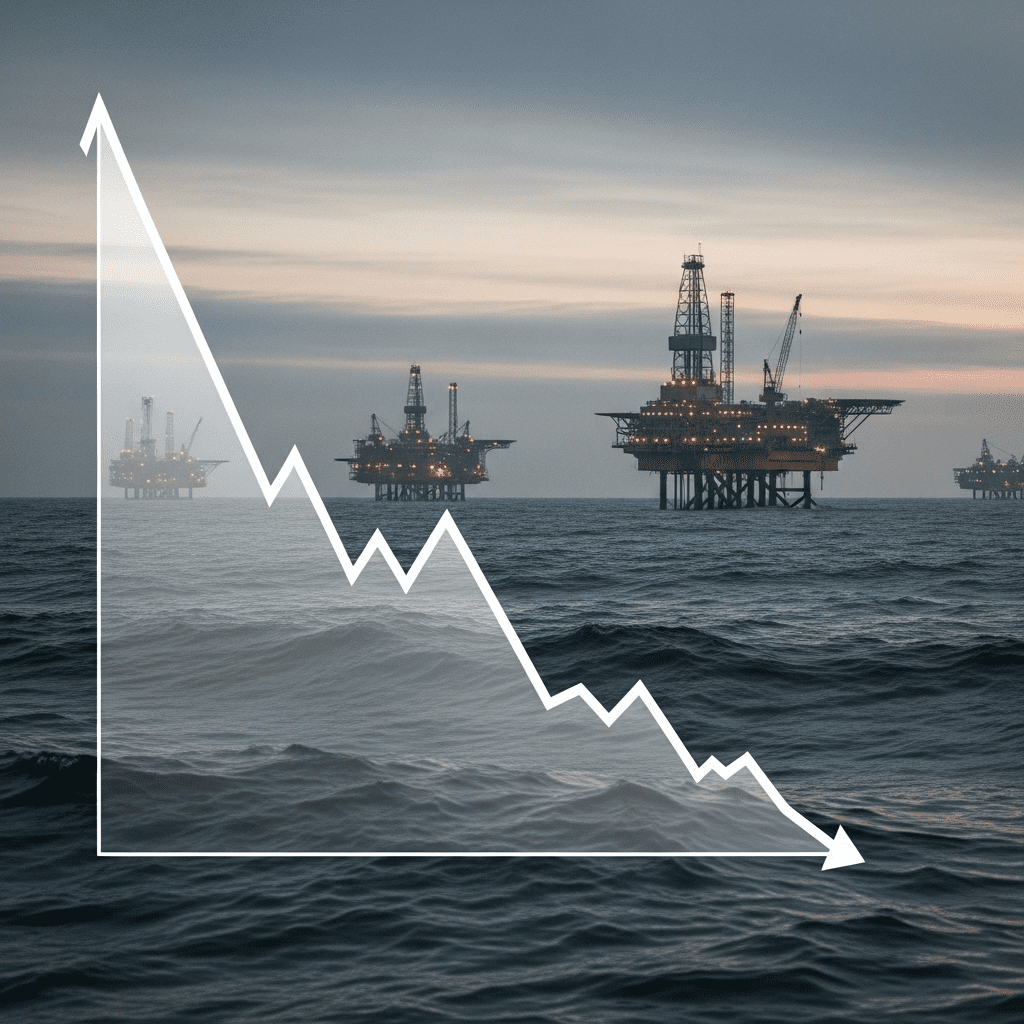
TL;DR: North Sea oil decline highlights UK energy security concerns as production drops to multi-decade lows in 2025, intensifying scrutiny on supply stability and investment prospects. Analysts warn of broad economic and market impacts as the sector faces accelerating output contraction.
What Happened
In 2025, the North Sea oil decline highlights UK energy security concerns after new data from the UK North Sea Transition Authority revealed a 12% year-on-year drop in crude output during the first half of the year; production has now fallen to under 900,000 barrels per day, marking the lowest level since the late 1970s. This sharp contraction follows a combination of aging offshore infrastructure, tight investment flows due to regulatory uncertainty, and stricter emission targets. According to a spokesperson from Offshore Energies UK, “The pace of decline is challenging, and the window for meaningful intervention is closing.” The government’s latest Energy Security Review flagged the reduced output as a risk point, international pressuring officials to balance decarbonization with supply reliability. Investment insights about the sector note structural underinvestment compounding production risks.
Why It Matters
This production downturn has far-reaching implications for the UK economy and broader European energy markets. With domestic output dwindling, UK reliance on oil and gas imports increases, creating exposure to global price volatility and geopolitical risk. In 2025, gas imports are projected to exceed 60% of domestic consumption, and oil imports now make up 40%, compared to 28% a decade ago (source: UK BEIS statistics, May 2025). The shrinking North Sea output also challenges government plans to ensure affordable domestic energy prices, critical for households and energy-intensive industries. According to a recent market analysis, persistent declines may complicate the UK’s net-zero transition by forcing increased reliance on imported hydrocarbons with higher carbon intensity.
Impact on Investors
Investors exposed to UK energy equities—particularly names such as Harbour Energy (LSE: HBR) and Serica Energy (LSE: SQZ)—face heightened risk as falling North Sea volumes weigh on revenue forecasts and asset valuations. Meanwhile, the FTSE 350 Oil & Gas Producers index is down 7% year-to-date, underperforming broader European energy benchmarks. Negative sentiment around regulatory headwinds and declining reserve bases could prompt portfolio rebalancing toward integrated energy majors or renewable transition plays. However, some see opportunity: persistent supply tightness may support global oil prices, benefiting firms with diversified or international exposure. Fixed income investors should monitor UK Gilts for inflationary pressure linked to higher import bills—key for forward-looking strategies discussed in recent sector outlooks.
Expert Take
Analysts note that “The North Sea’s accelerating decline leaves the UK increasingly vulnerable to external price shocks,” according to Citi’s European Energy desk. Market strategists suggest that while the decline is structurally driven, targeted tax incentives and regulatory clarity could moderate the pace and create niche investment opportunities.
The Bottom Line
The North Sea oil decline highlights UK energy security concerns in 2025, amplifying economic and market uncertainty just as policy challenges intensify. For investors, the sector’s future depends on regulatory direction, innovation, and global energy price dynamics. Strategic positioning and active risk management remain critical in this evolving landscape.
Tags: North Sea oil, UK energy security, oil production decline, energy sector, investment risks.