






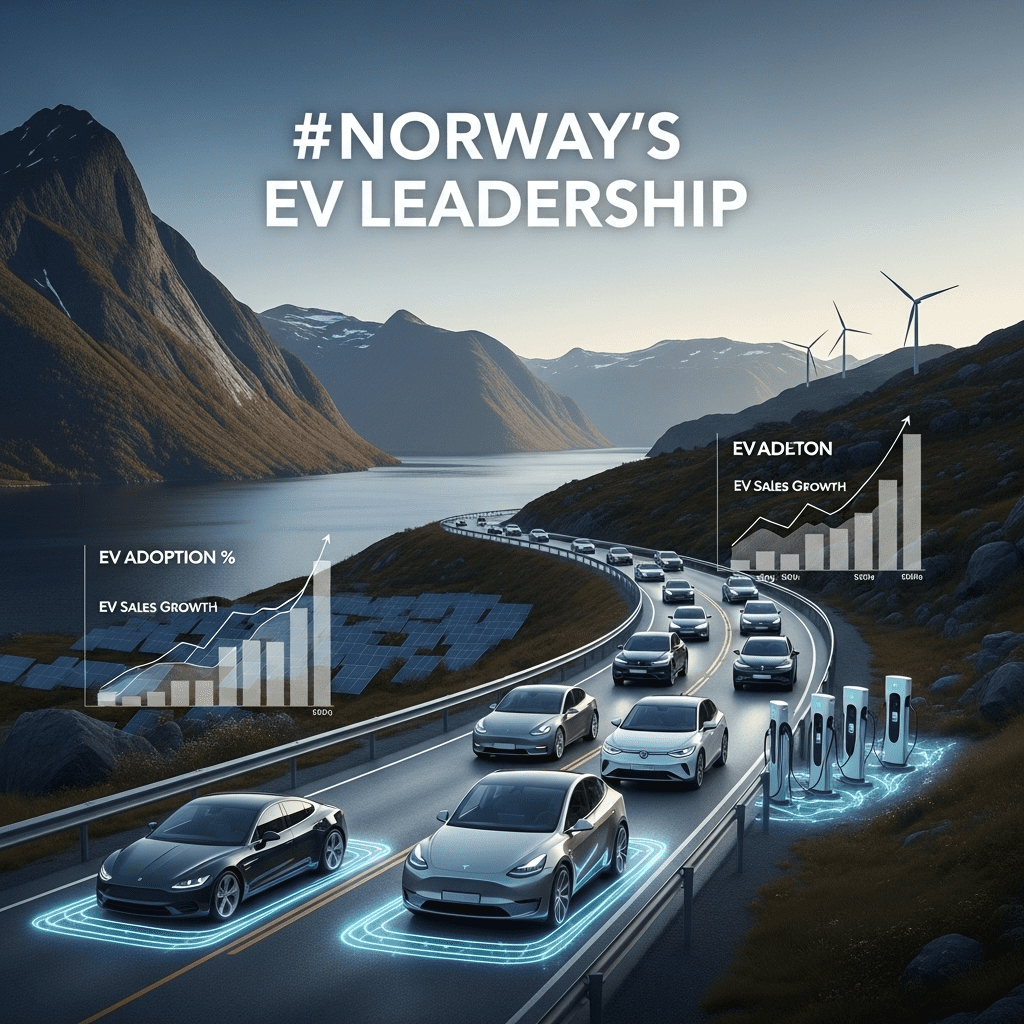
Norway leads global EV adoption in 2025, with electric vehicles accounting for a record-breaking share of new car sales. This development underscores the country’s transition from fossil fuels and has significant implications for the global energy and automotive sectors.
What Happened
Norway leads global EV adoption, achieving a milestone in 2025 as electric vehicles (EVs) comprised over 91% of new car registrations in the first half of the year, according to fresh data from the Norwegian Road Federation (OFV) reported by Reuters. This is up from 87% in 2024 and cements Norway’s status as the undisputed global frontrunner in EV adoption. Key models dominating the market include Tesla’s Model Y, Volkswagen’s ID.4, and Toyota’s bZ4X, even as legacy automakers accelerate their rollout of battery-powered options. Norway’s achievement comes amid targeted government policies, including a longstanding exemption of new EVs from value-added tax (VAT), road toll reductions, and robust charging infrastructure investments across the country. “Norwegian consumers have demonstrated a striking willingness to embrace electric mobility as the new normal,” said Christina Bu, Secretary General of the Norwegian EV Association. The rapid adoption has not only transformed buying patterns but also influenced broader European and global strategies.
Why It Matters
Norway’s accelerated transition to electric vehicles signals more than a national success story—it provides a roadmap for energy transition efforts worldwide. As the first country where internal combustion engine (ICE) vehicles approach obsolescence, Norway offers real-world data on grid adaptation, EV resale markets, and supply chain impact. The country’s journey comes at a time when the European Union targets a 100% reduction in new vehicle CO2 emissions by 2035, highlighting Norway as an early indicator for how other developed economies might follow suit or encounter challenges. Analysts at BloombergNEF note, “Norway’s experience demonstrates the tipping point electric vehicles may reach in other major auto markets if favorable policy and infrastructure align.” Complementing these trends, global automakers and energy utilities are now closely watching Norwegian data to recalibrate their strategies for capital investment and consumer engagement.
Impact on Investors
The surging EV adoption in Norway ripples through automotive, energy, and raw material sectors. For investors, this presents both opportunity and risk. Companies with strong EV portfolios—such as Tesla (TSLA), Volkswagen Group (VOW3.DE), and Toyota (TM)—continue to see increased demand in markets trending toward electrification. Meanwhile, raw materials suppliers focused on lithium, nickel, and cobalt may find more stable demand forecasts. Conversely, traditional automakers heavily exposed to ICE vehicles, as well as oil and gas incumbents, face mounting headwinds as their addressable markets shrink. “Norway’s EV trajectory signals the rate at which legacy automotive value chains must pivot to remain viable,” said Karianne Stensland, senior analyst at Arctic Securities. Utilities and charging infrastructure firms with recurring revenue models, including local players and international names like ABB (ABBN.SW), could also benefit as grid upgrades and charging needs rise. For a more comprehensive breakdown of these trends, visit ThinkInvest’s investment insights, detailed market analysis, and sector-specific deep dives.
Expert Take
Analysts note that Norway’s EV adoption curve represents a litmus test for the scalability of national energy transitions elsewhere. Market strategists suggest that watching Norway’s policy adjustments and secondary market for used EVs could inform timing and success in other geographies.
The Bottom Line
For investors and policymakers, Norway leads global EV adoption by proving scale is achievable with coordinated incentives and infrastructure. As the country rapidly phases out ICE vehicles, the Norwegian experience offers lessons for capital allocation, sector positioning, and regulatory risk as electrification accelerates worldwide into 2026 and beyond.
Tags: electric vehicles, Norway, energy transition, automotive markets, EV investment.