







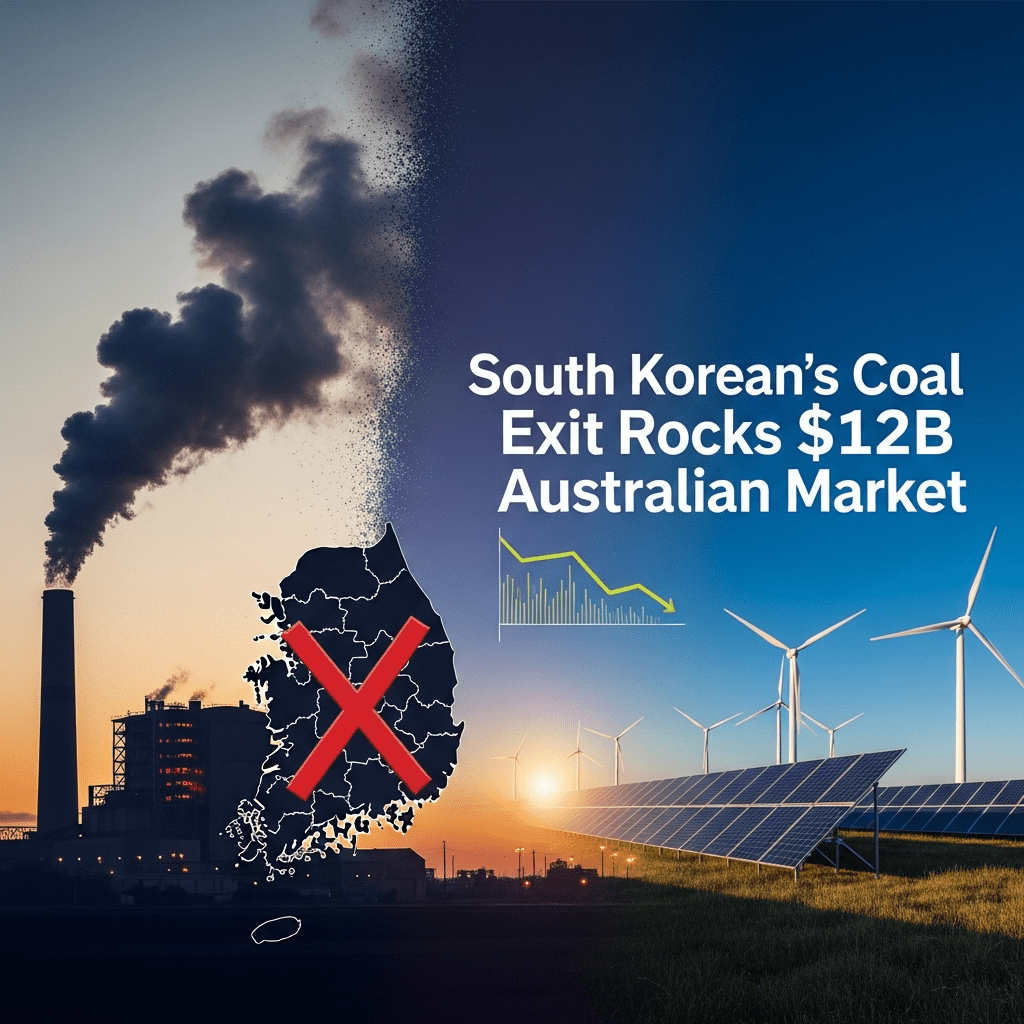
South Korea ($KOSPI) revealed a plan to retire all 58 of its coal-fired power stations by 2040, jolting Australia’s export market and putting at risk over $12 billion in annual coal trade. The South Korea coal exit impact now raises urgent questions for investors and exporters facing a sudden shift in Asian energy demand.
South Korea’s 2040 Coal Shutdown to Hit $12B Australian Export Market
The South Korean government formally announced intentions on November 18, 2025, to phase out all domestic coal power generation by 2040, according to the Ministry of Trade, Industry and Energy. This decisive move targets net-zero emissions by 2050 and involves shuttering 58 coal-fired plants—representing 37.5 GW, or roughly 38% of national electricity supply. For Australia, South Korea’s third-largest coal export market, this signals a pivotal challenge: in 2024 alone, the Australian Bureau of Statistics reports coal exports to South Korea totaled A$18.5 billion (USD $12.1 billion), accounting for nearly 14% of Australia’s total thermal coal trade volume. Spot coal prices on the Newcastle Exchange dipped nearly 8% to $128/tonne following the announcement (Bloomberg, Nov. 18, 2025), underlining market anxiety over long-term demand.
Asian Energy Markets Brace for Shifting Demand Patterns
South Korea’s coal exit accelerates broader decarbonization trends in the Asia-Pacific, signaling a structural realignment in regional energy flows. According to data from the International Energy Agency (IEA), coal accounted for nearly 28% of South Korea’s power mix in 2024, down from 40% in 2015. Neighboring Japan and Taiwan are also intensifying renewables adoption and are reviewing coal import contracts. Australian thermal coal exporters, already facing growing competition from Indonesia and shifting Chinese demand, now confront heightened price volatility. The KOSPI Utilities Index slid 2.6% after the government’s news, reflecting concerns about how utilities will adapt capital spending to replace coal with renewables and LNG (Nikkei Asia, Nov. 2025).
Investor Strategies: Managing Exposure Amid Export Uncertainty
For investors holding shares in coal producers like Whitehaven Coal ($WHC.AX), New Hope Corporation ($NHC.AX), and Glencore ($GLEN.L), South Korea’s decision supercharges debate over asset valuations and future profitability. With contracts worth billions facing renegotiation risk, portfolio diversification into renewables and lithium, as seen in stock market analysis, becomes increasingly prudent. Short-term traders may seek opportunities in LNG or renewable energy providers aiming to fill the supply gap, such as Korea Electric Power ($KEP). Asset managers tracking commodity-linked ETFs should closely monitor ongoing policy developments in Asian import markets and consult latest financial news for sector-specific updates. Long-term exposure to fossil fuel-heavy equities could increase portfolio volatility as Asian utilities transition to cleaner sources.
What Analysts Expect Next for Coal and Export-Focused Stocks
Industry analysts observe that the South Korea coal exit impact could accelerate a decline in seaborne thermal coal prices—especially if Japan amplifies its own phaseout plans. Market consensus suggests that while near-term spot prices will adjust to existing contracts, forward contracts for 2027–2030 may weaken further as alternative energy projects accelerate. Investment strategists note that Australian producers may pivot more rapidly toward metallurgical coal or battery minerals to offset the shortfall, but warn that revenue headwinds are likely to persist through the next decade.
South Korea Coal Exit Impact Signals Shift for Commodity Investors
South Korea’s decision ushers in a new era for commodity markets, underscoring systemic risks for exporters whose fortunes are tethered to a shrinking coal market. The South Korea coal exit impact is likely to reverberate far beyond 2040, prompting investors to reassess exposure, track policy developments, and diversify into growth segments less vulnerable to decarbonization shocks. Watch for evolving LNG demand and the Asian clean energy transition as the next major catalysts.
Tags: South Korea, coal exports, Australian coal, $WHC.AX, energy transition










