

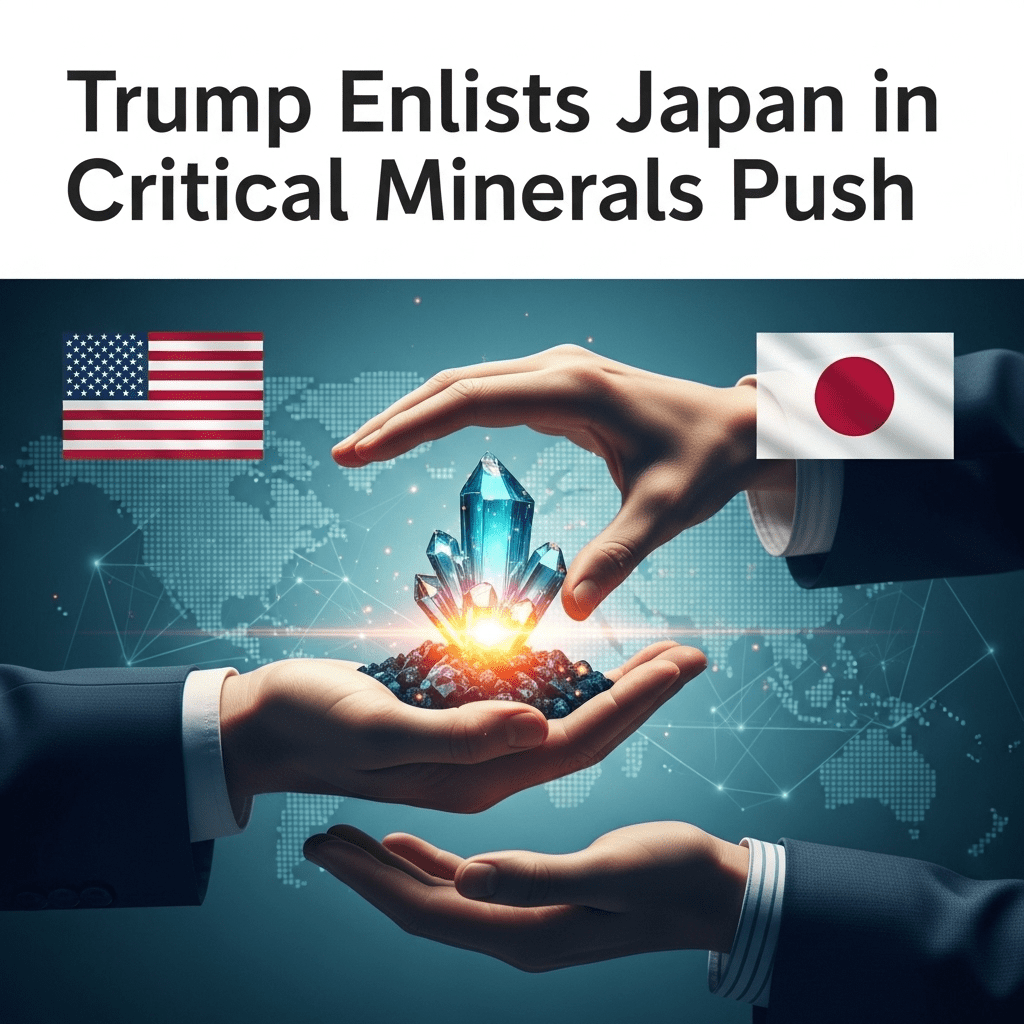
Trump enlists Japan in critical minerals supply efforts as part of a broader push in 2025 to secure essential materials for U.S. industries. This partnership seeks to reduce reliance on China, with far-reaching implications for technology, energy, and investment sectors.
What Happened
Former President Donald Trump has initiated a landmark partnership with Japan to bolster critical minerals supply chains, marking a significant policy direction for 2025. The agreement was formalized at a U.S.-Japan economic summit in Washington, where leaders announced expanded cooperation to secure rare earths, lithium, cobalt, and other strategic resources vital for semiconductors and electric vehicle (EV) batteries. According to Bloomberg, the accord includes joint investments in mining projects outside China and coordinated research on mineral processing technologies. Trump underscored the urgency, stating, “We must guarantee that America’s future is not held hostage by foreign suppliers.” The move follows a 2024 Department of Energy report highlighting that over 75% of the U.S. supply of rare earth elements originates from China, intensifying geopolitical and supply chain risks.
Why It Matters
The renewed drive involving Japan underscores critical minerals’ role as a linchpin in the global transition toward electrification and digitalization. As the U.S. and allies accelerate EV and clean energy adoption, access to rare earths and battery metals has become fiercely contested. Japan brings advanced materials processing and deep expertise in supply chain diversification, potentially reducing bottlenecks experienced during the pandemic and post-pandemic trade tensions. Analysts at Goldman Sachs estimate that global demand for lithium and rare earths will rise by 20% annually through 2030, and securing diversified sources is essential to prevent price shocks and supply disruptions. The memory of the 2010 China-Japan rare earth spat, which led to a surge in prices and market volatility, continues to inform current policy and investment choices (investment insights).
Impact on Investors
Investors are closely watching the critical minerals space, as this U.S.-Japan initiative signals both risks and opportunities. Companies engaged in battery materials and mining—such as Albemarle (NYSE: ALB), MP Materials (NYSE: MP), and Panasonic Holdings (TYO: 6752)—may benefit from capital infusions, policy incentives, and new joint ventures. However, the realignment could heighten volatility in existing supply contracts and prompt realignment of global trade flows. “For resource producers not aligned with the West, this raises uncertainty but also opportunity,” noted Amiko Saito, commodity strategist at Nomura Securities. “Japan’s involvement boosts credibility and could catalyze further diversification across Asia-Pacific.” Investors may also track indices such as the S&P Global Rare Earths Index to gauge broader market sentiment. As highlighted in recent market analysis, supply chain shifts may accelerate M&A and capital allocation in the metals and mining sector.
Expert Take
Analysts note that the Trump-Japan agreement could set a precedent for multilateral critical minerals alliances, reshaping how countries approach resource security and strategic tech investments. Market strategists suggest that supply chain resilience and geopolitical alignment are now central to metals and mining valuations.
The Bottom Line
The move to enlist Japan in critical minerals supply efforts marks a major pivot in U.S. strategy as global competition over resource security heats up. For investors, the Trump-Japan initiative in 2025 signals a reordering of supply chains and potential new winners across mining, technology, and EV sectors. Keeping close tabs on policy, trade developments, and sector updates remains critical as markets adapt to this shifting landscape.
Tags: critical minerals, Trump, Japan, rare earths, supply chain, EV, mining.




