







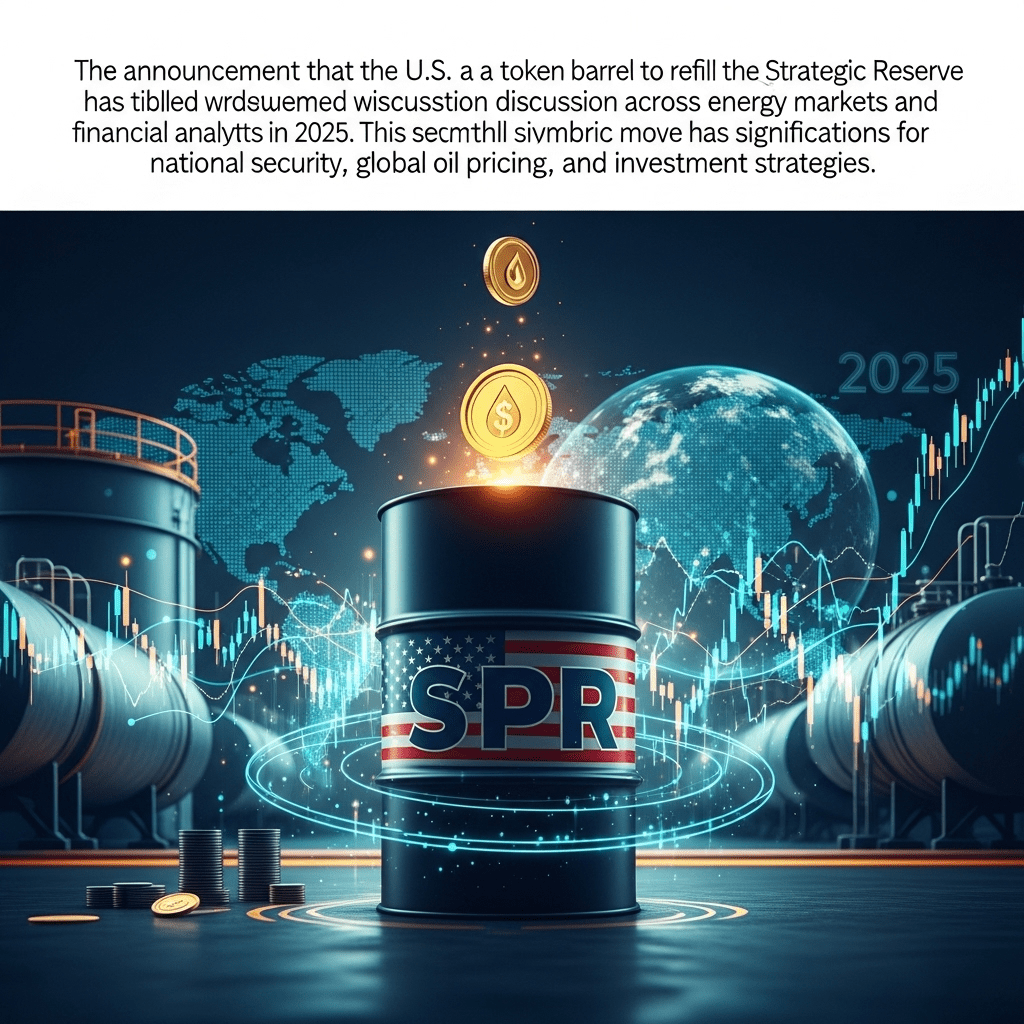
The announcement that the U.S. buys a token barrel to refill the Strategic Reserve has triggered widespread discussion across energy markets and among financial analysts in 2025. This seemingly symbolic move has significant implications for national energy security, global oil pricing, and investment strategies.
U.S. Buys a Token Barrel to Refill the Strategic Reserve: Strategy and Signal
In an era defined by volatile oil prices and heightened geopolitical tensions, the decision that the U.S. buys a token barrel to refill the Strategic Reserve is more than a trivial headline. The Strategic Petroleum Reserve (SPR), maintained by the U.S. Department of Energy, is the largest emergency crude oil storage globally, holding capacity for up to 714 million barrels. Throughout 2022 and 2023, the reserve was heavily drawn down to counteract market shocks and stabilize domestic fuel prices following global disruptions.
The recent move to purchase a minimal—often termed “token”—amount of oil signals a shift in U.S. energy policy. Rather than aggressively refilling the SPR during uncertain market conditions, a slow and cautious approach is meant to avoid inflating oil prices and disrupting delicate supply chains. For institutional and retail investors, this strategy illustrates how government policy can serve as both a market participant and a stabilizer.
The Impact on Oil Prices and Energy Security
Although buying a symbolic volume might appear inconsequential, the act itself communicates key policy intentions. Financial markets and commodity traders tend to react not just to volumes purchased, but to the message such actions convey. Analysts at ThinkInvest.org note that as the U.S. buys a token barrel to refill the Strategic Reserve, the administration showcases its intent to restore the SPR gradually, prioritizing market stability over political gains.
Energy security experts point out that the reserve still contains enough oil to mitigate short-term disruptions, but a prolonged period of under-refilling could raise longer-term risks, especially if geopolitical crises escalate. Market observers and investors will be closely monitoring how this slow-replenishment approach interacts with potential OPEC+ production cuts or sharper rises in global demand projected for late 2025.
Policy, Politics, and Market Perception
Historically, SPR purchases have been seen as both a logistical necessity and a political statement. The Biden administration’s measured pace is interpreted as attempting to walk a fine line—addressing concerns from environmental advocates about fossil fuel reliance, while also placating energy sector stakeholders and commodity investors worried about inventory shortfalls.
Furthermore, the optics of the U.S. buying only a token barrel is intended to avoid sparking accusations of market manipulation amid already-inflated gasoline prices for American consumers. The approach is also influenced by legislative pressures and the U.S. Congress’s oversight of national energy strategy, balancing fiscal discipline with the need to maintain strategic reserves at robust levels.
Investment Ramifications as U.S. Buys a Token Barrel to Refill the Strategic Reserve
For investors, the policy of minimal SPR refills underscores the importance of closely tracking government actions in the energy market. Energy equities, oil ETFs, and related sectors may see reduced volatility in the short term, as the absence of large government buying sprees allows natural price mechanisms to play out. However, the underlying risk of prolonged under-refilling cannot be ignored, especially for those with long exposure to U.S. energy infrastructure and supply chains.
Portfolio managers on alternative assets desks are also reevaluating their exposure to oil futures, taking into account the probability of heightened SPR purchasing in the event of future crises. Strategic diversification remains crucial, as cross-asset correlations increase during global commodity shocks.
Global Oil Market Dynamics and Future Outlook
The decision that the U.S. buys a token barrel to refill the Strategic Reserve is being watched closely by OPEC+, European energy ministers, and major Asian importers. If U.S. refill rates accelerate, it could provide upward pressure on benchmark crude prices, complicating inflation control efforts both domestically and abroad. Conversely, a slow pace may embolden certain producers to implement tighter supply controls, knowing the U.S. is not a significant near-term buyer.
As the world transitions toward renewable energy, the pace and manner of SPR refilling will become a barometer for how the U.S. manages legacy energy assets while advancing toward sustainability targets. Investors seeking long-term growth opportunities must weigh these energy security policies against broader trends like electrification, battery storage, and green investing.
Conclusion: Strategic Shifts Reflected in Token Purchases
In summary, the headline that the U.S. buys a token barrel to refill the Strategic Reserve encapsulates broader shifts in American energy and investment policy for 2025. By acting deliberately rather than reactively, U.S. policymakers aim to maintain flexibility in a rapidly evolving global landscape. For financial professionals, market watchers, and energy investors, tracking these nuanced government actions will be vital to capturing both risks and rewards in an uncertain decade.










