

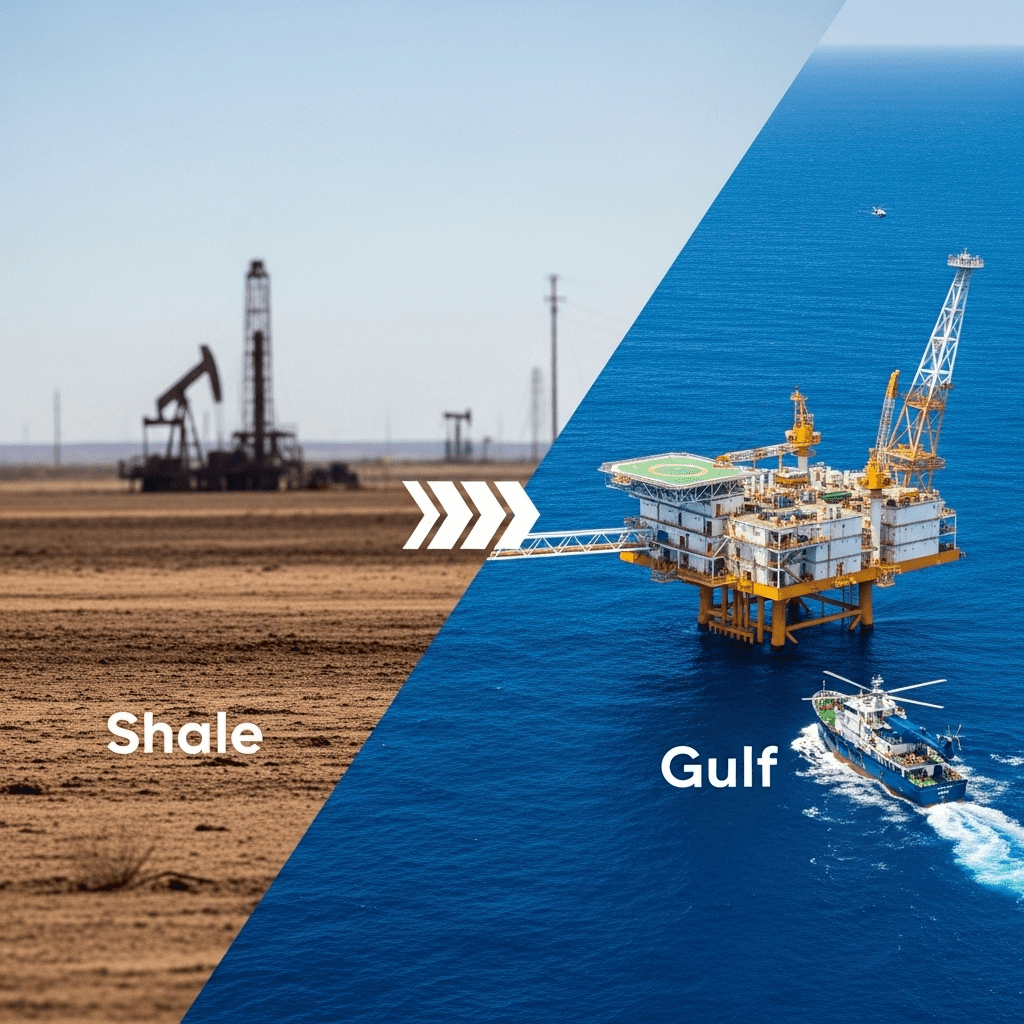
Amid changing market dynamics and evolving energy strategies, U.S. oil growth shifts from shale to Gulf as offshore production surges to the forefront. This significant trend is reshaping America’s role in the global energy market, as the Gulf of Mexico emerges as a key driver for future oil output, marking a tidal shift from the shale boom of the previous decade.
Why U.S. Oil Growth Shifts from Shale to Gulf
In the past ten years, shale oil—extracted through hydraulic fracturing and horizontal drilling, mainly in regions like the Permian Basin—propelled the United States to become the world’s top oil producer. However, as easy-to-access shale reserves mature and drilling productivity plateaus, producers are increasingly turning to the Gulf of Mexico’s vast offshore reserves for new growth opportunities.
This strategic migration is driven by several factors. Firstly, Gulf projects typically yield larger output per well, benefiting from technological advances in deepwater drilling. Secondly, the economics of offshore production have improved, with costs falling and break-even prices now approaching—or even outpacing—those in mature onshore fields. If you are seeking diversified energy investment insights, monitoring these cost dynamics is crucial for long-term portfolio decisions.
Offshore Production Outpaces Shale in 2025
The U.S. Energy Information Administration (EIA) projects that offshore crude output from the Gulf will reach its highest levels since 2019, with major expansions from large-scale projects operated by Shell, Chevron, and BP. In contrast, onshore shale production, especially in the Permian and Eagle Ford basins, is showing only modest gains due to drilling slowdowns, tightening capital discipline, and environmental pressures.
According to industry analysts, new fields like Shell’s Vito and BP’s Argos platforms are set to add hundreds of thousands of barrels per day to the national tally. This incremental Gulf supply helps mitigate the flatlining of shale, positioning the U.S. as a stable supplier in an increasingly turbulent global market.
Implications for Investors as Oil Growth Shifts from Shale to Gulf
For investors and energy stakeholders, the fact that U.S. oil growth shifts from shale to Gulf presents both challenges and opportunities. Offshore projects generally require higher upfront investment and longer lead times but often deliver more predictable, long-term cash flows compared to the short-cycle nature of shale. This shift may benefit large integrated oil companies and offshore service providers, potentially altering the risk and return calculus for energy portfolios.
This evolution also impacts infrastructure development and supply chain demands. With offshore barrels poised to feed U.S. Gulf Coast refineries and export terminals, there may be new opportunities in midstream logistics and export infrastructure. For in-depth discussions on trending sectors, see our latest market analysis reports.
Policy, Environmental, and Geopolitical Considerations
Sustained growth in the Gulf brings policy and environmental issues to the forefront. Offshore drilling remains subject to federal leasing policies, rigorous permitting, and environmental scrutiny. In 2024 and beyond, the Biden administration has balanced climate goals against energy security, approving select leases while promoting decarbonization technologies to reduce emissions intensity per barrel.
Internationally, robust Gulf production affirms U.S. energy independence and provides a buffer against global supply disruptions—factors that are increasingly prioritized given geopolitical unrest and OPEC+ production strategies. Strategic investors watch these developments closely for signals on price volatility and regional supply balances.
Future Outlook: Will the Gulf Sustain Long-Term U.S. Oil Growth?
Looking ahead to 2025 and beyond, the question of whether the Gulf can anchor U.S. oil growth is top of mind. Massive discoveries and upgraded facilities indicate strong potential through the late 2020s. However, the industry must navigate challenges including escalating regulatory compliance, competition from renewables, and evolving ESG expectations.
What’s clear is that as U.S. oil growth shifts from shale to Gulf, investors must adapt strategies to capture emerging value in offshore assets, supply chain plays, and companies leading in low-carbon innovation. For more on adapting to energy transitions in your portfolio, explore our expert asset allocation strategies.
Conclusion
The changing landscape of U.S. oil production signals profound implications for energy markets, corporate strategy, and investment portfolios. With Gulf of Mexico output surging and shale growth decelerating, a new chapter is underway—demanding informed analysis and agile, forward-looking decisions to harness this momentum in 2025 and beyond.




