




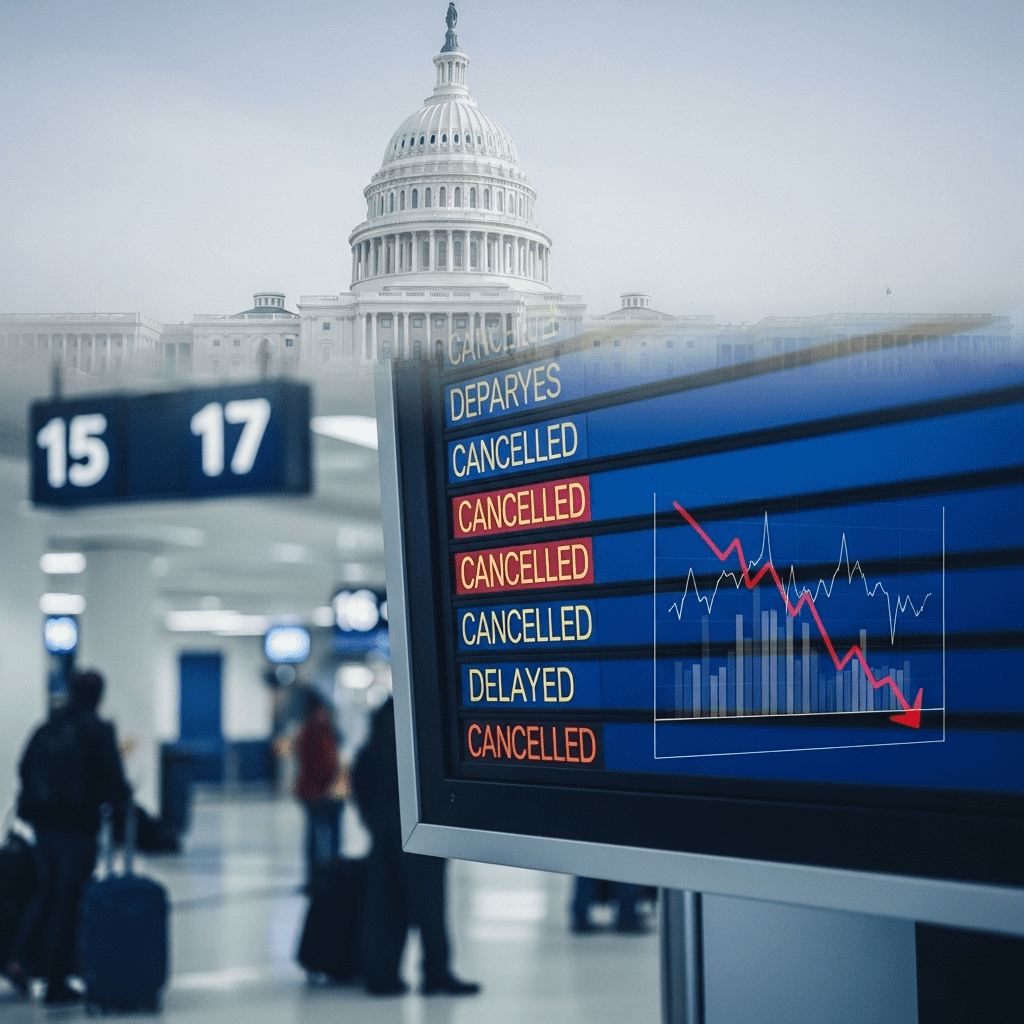
As the US government shutdown enters its third week, US flight cancellations rise across the nation’s busiest airports, sparking concern throughout the travel sector and among financial analysts. The escalation in airline disruptions has become a major economic story, with industry leaders warning of mounting losses and ripple effects on wider economic activity.
US Flight Cancellations Rise Amid Prolonged Government Shutdown
The sharp uptick in flight cancellations has been directly linked to the prolonged government shutdown, which has hampered the operations of the Federal Aviation Administration (FAA) and the Transportation Security Administration (TSA). Data from major carriers including Delta, United, and American Airlines reported a combined 7% hike in cancelled flights compared to the same period last year. Airports in key hubs such as Atlanta, Chicago, and Dallas have seen operational slowdowns as federal workers face extended furloughs and staffing shortages.
For travelers, the consequences have ranged from missed connections to significant financial losses, while airlines have warned of reduced service reliability and deteriorating customer satisfaction. Industry experts predict that, should the shutdown extend further, air traffic disruptions could deepen, impacting both domestic and international routes.
Ripple Effects on the US Economy
The wider economic implications of these disruptions are significant. The surge in US flight cancellations puts pressure on airlines, airport vendors, and the tourism sector, triggering financial uncertainty for thousands of workers dependent on smooth airport operations. According to the U.S. Travel Association, the travel sector contributes more than $1.1 trillion annually to the economy and employs over 9 million Americans.
Every day of the shutdown risks further eroding consumer confidence and business investment, with companies facing higher logistical costs and productivity losses. Economists at Moody’s Analytics estimate that the ongoing government shutdown could shave up to 0.2% off quarterly GDP growth if it extends much further, mainly due to the transportation disruption and delayed government contracts.
Airlines and Investors Respond to Market Turbulence
Airline stocks have exhibited increased volatility, reflecting investor worries about revenue declines from cancelled flights and lower demand. Delta Air Lines, for example, saw its shares drop 3% this week as executives revised Q1 forecasts downward to account for rising operational costs and lost revenue.
Some investors, however, are seeking opportunities amid the volatility, hedging against further sector declines or looking for short-term bargains as the situation evolves. Industry analysts advise caution, noting that while short-term disruptions can create attractive entry points, an extended shutdown risks deepening damage to balance sheets and future earnings predictions.
Government Employees and Air Traffic Safety Concerns as US Flight Cancellations Rise
The growing number of cancelled flights has placed unprecedented pressure on federal workers, with up to 80% of FAA employees either furloughed or working without pay. TSA agents—crucial for airport security—have also been forced to work without compensation, leading to increased absenteeism and longer security lines.
Union representatives have raised alarms over air traffic safety, highlighting the risk posed by reduced staffing and diminished morale. “Aviation safety should never be compromised by political gridlock,” warned Sara Nelson, president of the Association of Flight Attendants. The National Air Traffic Controllers Association echoed these concerns, urging lawmakers to prioritize immediate funding for aviation services.
Potential Long-Term Impacts
The effects of US flight cancellations rise beyond immediate disruptions, with possible long-term consequences for business travel, conference schedules, and supply chains. US-based multinational firms reliant on just-in-time logistics could face delayed shipments and missed contractual obligations, ultimately impacting their competitiveness in global markets.
For individual investors, analysts at ThinkInvest.org recommend closely monitoring airline earnings reports, industry statements, and government signals, noting that further uncertainty could present both risks and select sector rotation opportunities.
How the Travel Sector and Passengers Are Adapting
To mitigate losses as US flight cancellations rise, airlines are re-routing aircraft and consolidating flights, while travel agencies are revising rebooking policies and waiving certain fees. Many travelers are turning to online resources for up-to-date flight status and alternative transport solutions, underscoring the importance of real-time information in crisis periods.
Meanwhile, airport retail and hospitality providers, facing reduced foot traffic, are intensifying loyalty offers and partnerships in an attempt to sustain revenues until normal flight operations resume. Investors following the travel sector should keep a watchful eye on these adaptive strategies and their impact on bottom-line results.
Outlook: What’s Next for Air Travel and the US Economy?
With no clear resolution in sight, experts warn that US flight cancellations will likely persist—and possibly accelerate—if the government shutdown continues into a fourth week. Both policymakers and airline stakeholders are urging for a rapid end to the impasse to restore confidence across the travel sector and maintain economic momentum.
For financial professionals monitoring market risk or seeking economic trends impacting portfolio allocations, the current environment highlights the interconnectedness of government policy, operational logistics, and investment outcomes. Continued vigilance and adaptive strategy are recommended as uncertainties persist around government negotiations and their downstream effects.