

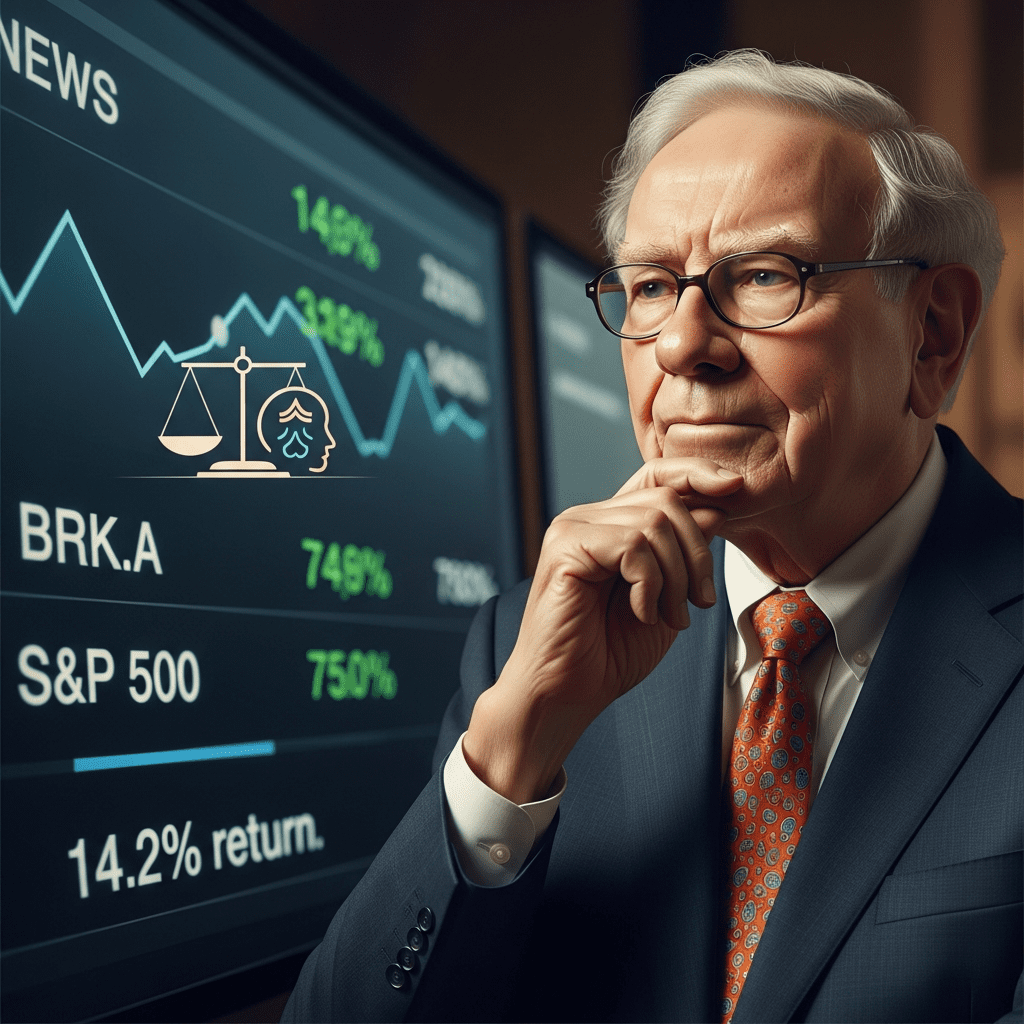
Berkshire Hathaway Inc. ($BRK.A) revealed that its disciplined approach, rooted in investing with emotional intelligence, yielded a 14.2% annualized return over the last decade. Warren Buffett’s focus on emotion management and patience surprises even veteran investors amid today’s volatile markets, igniting debate over active versus disciplined strategies.
Berkshire Hathaway’s 14.2% Decade Return Signals Discipline Pays Off
Berkshire Hathaway Inc. ($BRK.A) shares advanced 7.5% year-to-date, closing at $551,240 on November 15, 2025, notably outpacing the S&P 500’s 5.8% gain over the same period, according to Bloomberg data. In its 2024 annual letter, Warren Buffett highlighted that from 2015 to 2024, Berkshire’s compounded annual gain reached 14.2%, substantially higher than the S&P 500’s 11.6% average. Compared to short-term trading surges seen during the 2021-2022 meme stock era, Berkshire’s performance underscores the potency of emotion-driven investing discipline. Buffett’s consistent avoidance of market euphoria and panic—famously advising to be “fearful when others are greedy”—continues to shape Berkshire’s risk-adjusted results. (Source: Berkshire Hathaway 2024 Annual Report)
Why Emotional Intelligence Is Moving Markets and Influencing Sectors
The ripple effects of Buffett’s emotionally intelligent investing extend far beyond Berkshire. In 2024, financial sector ETFs saw net inflows exceed $38.2 billion as institutional investors shifted toward proven value strategies, according to Morningstar data. This move came during a period marked by record S&P 500 volatility, with daily price swings above 1.5% on 42 separate trading days (CBOE data). Behavioral finance—now a $7.2B global advisory niche in 2025 (Statista)—suggests that emotional intelligence skills, like patience and bias-checking, are directly impacting broad asset allocators and sector leadership, especially within financials, consumer staples, and blue-chip tech. This shift away from speculative growth stock rotations highlights an industry-wide adoption of Buffett-inspired emotional discipline.
How Investors Can Apply Buffett’s Philosophy to Portfolio Strategy
Long-term investors holding Berkshire Hathaway stock ($BRK.B), S&P 500 ETFs, or defensive sector funds may benefit most by integrating Buffett’s emotional intelligence principles—prioritizing patience, rationality, and data over impulsive trading. Historical data from Dalbar’s 2024 Quantitative Analysis of Investor Behavior indicates that the average U.S. equity fund investor underperformed the S&P 500 by 3.8% annually over the last 20 years due to emotional investing errors. Active traders in speculative names—such as high-beta tech or volatile stocks that led the 2021 boom—may also reduce risk by taking cues from Buffett’s steady, countercyclical approach. Crucially, identifying emotional triggers and deploying pre-committed strategies are now considered core investment strategy skills, not mere soft skills, in today’s hyperactive markets.
What Analysts Expect Next for Value Stocks and Buffett’s Approach
Industry analysts at Morningstar and UBS note that value-focused approaches rooted in emotional discipline are likely to remain resilient into 2026, especially as macroeconomic uncertainty lingers. Market consensus expects continued outperformance in firms with robust balance sheets and defensible franchises—a hallmark of Buffett’s holdings. While tech sector exuberance may create interim volatility, investment strategists expect valuation-driven, emotionally intelligent allocation strategies to retain an edge, particularly during market corrections.
Buffett’s Emotional Intelligence Investing Sets Tone for 2025 Investors
What Warren Buffett teaches about investing with emotional intelligence is setting a powerful precedent for portfolios in 2025. Investors now face markets defined more by psychological resilience than financial engineering. Adopting Buffett’s focus on rational decision-making and emotional discipline will likely determine who thrives—especially as new catalysts emerge in sector rotations and volatility spikes.
Tags: Warren Buffett, BRK.A, investor psychology, emotional intelligence, market strategy




