

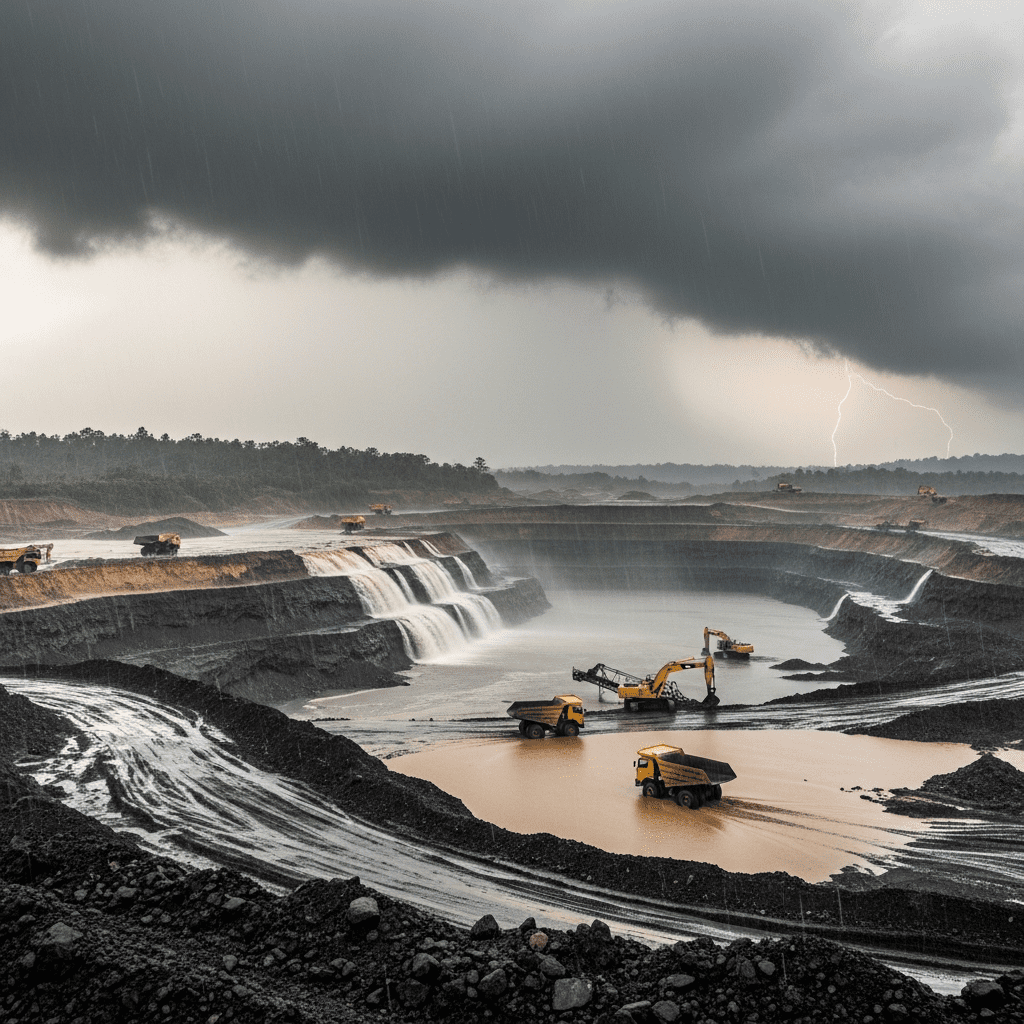
Indonesia’s coal exports tumbled 12% in Q3 2025, sending shares of Adaro Energy ($ADRO.JK) down 4.7%. As torrential rains batter mining regions, investor attention turns to Indonesia’s coal mindset and the nation’s exposure to climate-linked volatility.
Indonesian Coal Exports Slide as Weather Disrupts Production
Indonesia, the world’s largest thermal coal exporter, reported a sharp 12% drop in outbound shipments in Q3 2025 compared to the same period last year, according to data from Indonesia’s Ministry of Energy and Mineral Resources. Rainfall in East Kalimantan, a core mining province, surged 16% above the historical Q3 average, forcing multiple producers—including Adaro Energy ($ADRO.JK) and Bayan Resources ($BYAN.JK)—to issue output warnings. As a result, Adaro’s Q3 production slipped to 13.7 million tons, down from 15.1 million tons a year earlier (company filing; Bloomberg, Nov 2025). On the Jakarta Stock Exchange, Adaro shares fell nearly 5% on the day the data was released, underperforming the broader IDX Energy Index, which dipped 1.3%.
The nation’s total coal export value for Q3 hit $6.4 billion, down from $7.1 billion in Q3 2024 (Bank Indonesia). Spot prices for Indonesian 4,200 kcal coal slipped to $51/ton on Indonesia Coal Index 5 (ICI-5)—a 9% annualized decline—yet supply disruptions left Chinese buyers scrambling for other sources. State utility PLN also reported unplanned supply shortfalls at two Java power plants, citing weather-related coal delivery delays.
Coal Sector Vulnerability Grows Amid Extreme Weather Shifts
Indonesia’s coal sector, historically prized for stability and low extraction costs, now faces rising operational risks as weather unpredictability intensifies. Climate researchers note 2025 seasonal rainfall variability exceeded projections, signaling a breakdown in once-reliable monsoon patterns (financial news coverage). In the first ten months of 2025, coal mining disruptions contributed to a 6% cut in national power plant stockpiles, forcing PLN to tap emergency imports from Australia and Vietnam (Reuters, Oct 2025).
Coal contributes about 45% of Indonesia’s total energy supply and accounted for nearly 18% of state revenue in 2024 (Finance Ministry annual report). However, surging volatility poses challenges not only to power grid reliability, but also to export revenues, employment for over 900,000 direct and indirect workers, and the government’s efforts to attract foreign investment to the capital-intensive mining sector. The MSCI Indonesia Energy Index returned only 2.6% year-to-date through November 2025, compared to an 18% rally in the broader MSCI Asia Energy benchmark (Bloomberg index data).
Compounding the challenge is global decarbonization pressure. The International Energy Agency projects Indonesian coal demand will shrink 15% by 2030 as China and India boost renewables uptake. Fitch Ratings has also flagged Indonesia’s persistent overreliance on coal as a risk for sovereign credit ratings, especially as coal prices soften and financing costs for fossil fuel projects rise.
Investor Strategies: Navigating Transition in Indonesia’s Energy Market
For equity investors, Indonesia’s coal shakeup calls for a recalibration of risk and opportunity. Shares of major coal exporters like Adaro ($ADRO.JK), Bayan Resources ($BYAN.JK), and Indo Tambangraya Megah ($ITMG.JK) remain exposed to operational disruptions. In Q3, Adaro’s operating margin narrowed to 23.1% from 29.4% a year earlier (company report), while Bayan’s EBITDA fell 11% sequentially as logistics costs jumped.
Institutional investors are increasingly hedging coal exposure by tilting portfolios toward Indonesian renewables—especially companies with power purchase contracts from PLN. Energy transition plays such as Barito Renewables Energy ($BREN.JK)—which saw shares up 32% year-to-date, outperforming the coal industry—have become focal points for sustainability-focused funds. Diversifying into logistics, port infrastructure, and ancillary services around energy supply chains may also help mitigate direct weather risk.
Ultimately, investors tracking stock market analysis in the region should monitor government moves on renewables feed-in tariffs, coal export restrictions, and carbon tax implementation. The evolving regulatory environment and intensifying ESG scrutiny are reshaping fundamentals across all Indonesian energy plays. For those seeking cross-asset correlation, coal-linked currency volatility—IDR’s 4.1% decline against the USD in Q3—offers tactical opportunities for hedging exposures (Bank Indonesia data). More details on these structural shifts can be found in ThinkInvest’s regular energy market outlooks.
Analysts See Weather, Policy, and Energy Transition Risks Ahead
Market strategists caution that Indonesia’s energy sector faces structural headwinds in the medium term. According to a Q4 2024 Bloomberg survey, 71% of institutional investors believe coal will lose market share in Indonesia’s primary energy mix before 2030. The Asian Development Bank has emphasized that unmitigated climate impacts could reduce Indonesia’s GDP growth by 0.7% per year through the end of this decade (ADB, 2024 climate risk report).
On the policy side, government delays in renewables auctions and uncertain carbon pricing have contributed to capital outflows from the nation’s energy equities. The 2023 Just Energy Transition Partnership, intended to mobilize $20 billion for renewables between Indonesian ministries and a G7-backed consortium, remains under-executed, with only $2.5 billion disbursed by mid-2025 (official filings; Reuters, Aug 2025). Analysts at Fitch and HSBC have downgraded near-term coal sector outlooks, highlighting both physical and regulatory risks.
For investors, scenario planning is crucial: even moderate rainfall distortion could remove over 10 million tons of capacity from the market annually. Most experts recommend increased scrutiny of weather risk modelling in portfolio decisions and active engagement with both fossil and renewables sectors as Indonesia’s energy policy evolves.
Indonesia’s Coal Mindset: Pivoting to Stability in an Unpredictable Era
Looking ahead, the case for shifting Indonesia’s coal mindset is becoming urgent for policy makers, investors, and global partners alike. As extreme weather disrupts output and revenue stability, the limitations of legacy coal strategies are clear: capital, jobs, and national energy security are all at risk from climate-linked volatility. Accelerating investments in grid resilience, renewables capacity, and sustainable finance will be critical for restoring predictability to both Indonesia’s power sector and its export performance.
For forward-looking investors, Indonesia’s unresolved energy transition is both a risk and an opportunity. A rigorous evaluation of climate-exposed assets—paired with exposure to local renewables and supporting infrastructure—offers the best playbook for weathering volatility. Full sector exposure, whether via equities or local currency assets, now requires deep awareness of how Indonesia’s coal mindset may shift amid climate, regulatory, and investment headwinds.
Tags: Indonesia, coal, energy transition, renewables, climate risk




