




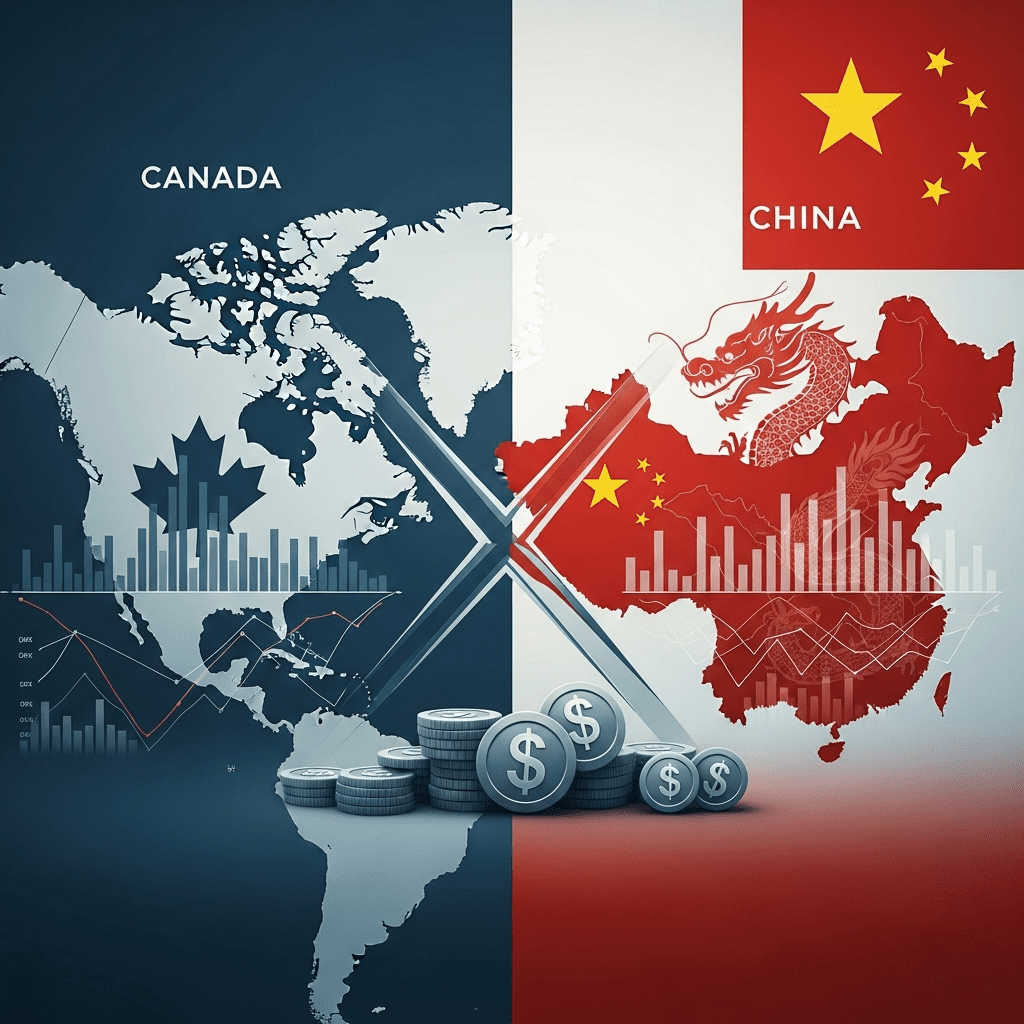
Mark Carney, former Bank of Canada governor, revealed Canada ($EWC) cannot expect China tariffs to be lifted immediately, dashing hopes for a swift trade policy shift. The statement on Canada China tariffs 2025 comes as global markets anticipate possible thawing in Sino-Canadian relations. Investors are left questioning when relief for affected sectors will materialize.
Carney: No Quick End to Canada China Tariffs in 2025 Talks
Mark Carney’s comments on November 1, 2025, make clear that Canada ($EWC) faces a protracted path to removing Chinese tariffs, despite renewed diplomatic engagement. Since 2018, Canadian exports to China have slumped 17.3%, falling from CA$27.7 billion to CA$22.9 billion as of 2024, according to data from Statistics Canada. Tariffs on canola and pork, which reached effective rates of 25% and 45% respectively after Beijing’s retaliatory measures in 2019, continue to weigh on Canadian agribusiness. Carney stressed that “trade normalization is a gradual, not transactional, process,” undermining expectations that a political handshake could prompt an immediate rollback. Market participants are now recalibrating their timelines and assessing the impact on corporate earnings for Canadian exporters, including key players in agriculture and minerals.
How China Tariffs Are Reshaping Canada’s Export Landscape
For Canadian sectors deeply linked to Chinese demand, the prolonged tariffs represent a material drag. The agricultural sector—especially canola, which accounted for CA$2.7 billion in pre-tariff exports to China—faces restricted access and ongoing price discounting relative to global benchmarks. The metals and energy sectors have also seen volume reroutes, with Canadian potash exports to China falling 12% year-on-year in 2024 as reported by the Canadian Trade Commission. Broader economic data reflect these trends: Canada’s overall exports to China declined to 3.7% of total outbound trade in 2024 from a peak of 5.1% in 2017. Given China’s position as the country’s second-largest single-country export market, these shifts are affecting GDP forecasts and investor sentiment. Historical precedents from the U.S.-China trade war indicate that even phased tariff relief can take 12 to 36 months to materialize in actual trade flows, making near-term recovery for affected Canadian firms unlikely.
Investor Playbook: Navigating Delayed Canada China Tariff Removal
Investors exposed to Canadian exporters, especially those in agri-food and resource sectors, need to factor in ongoing tariff headwinds through at least mid-2026. Companies like Nutrien Ltd. ($NTR) and Richardson International are likely to see margin compression persist, while smaller agri-tech firms face cash flow constraints. For those targeting broader sector exposure, Canada’s stock market analysis pages suggest monitoring the S&P/TSX Capped Materials Index, which underperformed the benchmark by 4.2% year-to-date as of October 2025 (Bloomberg). Diversification into markets less sensitive to Chinese tariffs, such as U.S. or ASEAN-focused equities, may provide tactical risk management. Investment strategy experts also recommend keeping an eye on diplomatic calendars and trade policy releases for actionable catalysts. Investors should remain alert for sector rotation or relief rallies if negotiations show unexpected progress, but base cases must assume tariffs will persist across the next few quarters.
Outlook: What Analysts Expect for Canada China Trade in 2026
Industry analysts observe that the path to full normalization between Canada and China will remain “incremental at best” for 2026. Most see the current tariffs as deeply entrenched in a broader geopolitical standoff, limiting prospects for quick policy reversals. Market consensus suggests that relief could come in the form of phased quota increases or targeted sanction suspensions for strategic commodities, rather than unilateral tariff elimination. As a result, earnings outlooks for Canadian exporters are being revised downward for the next two to three quarters, reflecting ongoing uncertainty and trade friction.
Canada China Tariffs 2025 Signal Prolonged Uncertainty for Exporters
The news that Canada China tariffs 2025 are unlikely to be lifted quickly underscores ongoing headwinds for Canadian export-driven sectors. Investors should monitor both diplomatic signals and sector-level performance data as policy moves remain unpredictable. Maintaining portfolio flexibility and close attention to latest financial news will be critical as the trade landscape continues to evolve.
Tags: Canada, China, tariffs, EWC, trade policy