





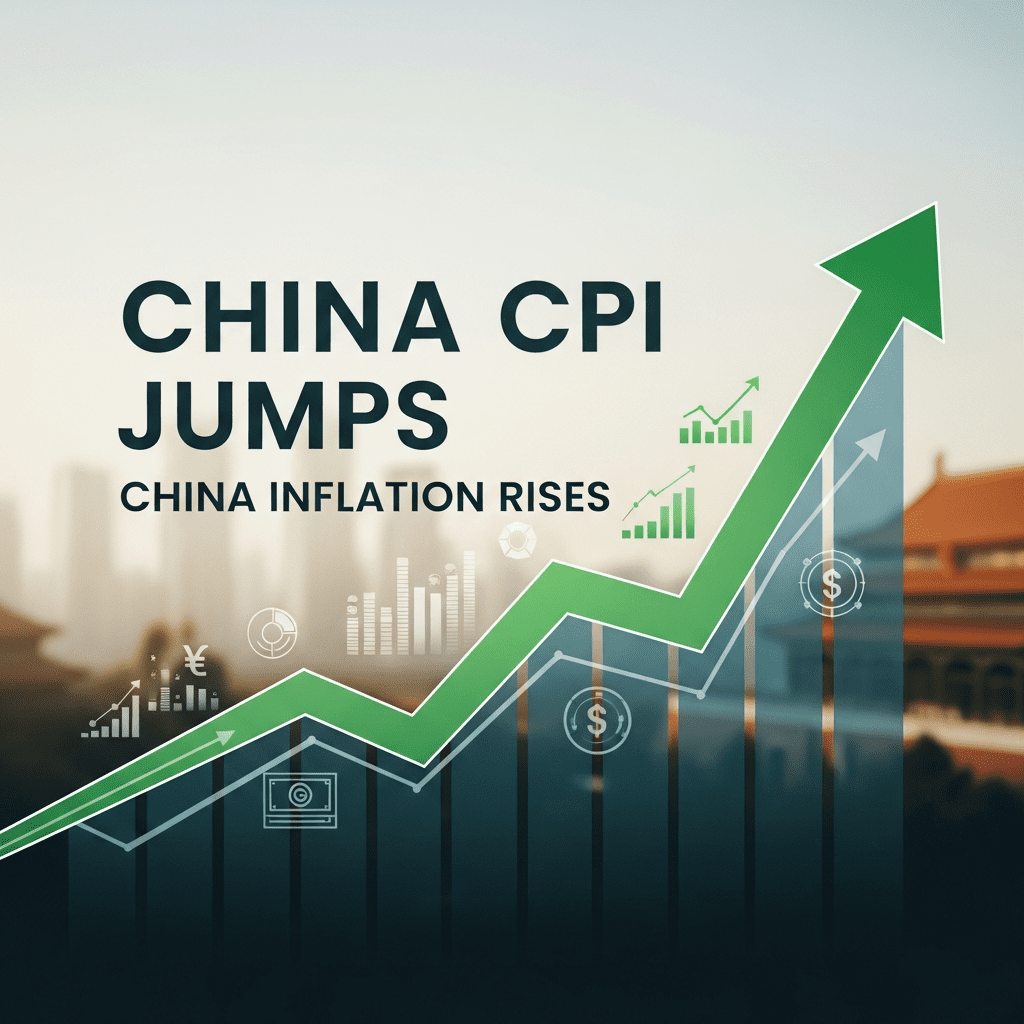
China’s National Bureau of Statistics ($CPI_CHN) revealed October’s consumer prices unexpectedly jumped 0.3% year-on-year, defying market forecasts of no change. The China consumer prices rise, driven by robust holiday demand, has investors reassessing deflation risks and future policy actions.
China CPI Climbs 0.3% in October Amid Holiday Surge
China’s Consumer Price Index (CPI) advanced 0.3% year-on-year in October 2025, reversing three consecutive months of price stagnation, according to official National Bureau of Statistics data released November 9. Market consensus, polled by Reuters, had anticipated a flat CPI reading. October’s food prices rose 1.5% versus September’s 0.8% decline, led by a 6.8% spike in pork prices and increased demand for fresh vegetables during the National Day holiday. Non-food price growth remained muted, edging up just 0.2% year-on-year. The Producer Price Index (PPI), however, continued to decline at -2.2%, reflecting persistent manufacturing sector weakness.
How China Consumer Price Gains Signal Shifting Economic Momentum
The unexpected rise in China’s consumer prices signals a turning point for Asia’s second-largest economy, which has grappled with persistent deflation risks for most of 2025. Since January, headline inflation had hovered close to zero or dipped negative, raising concerns about weak domestic demand. October’s rebound comes as retail sales during the eight-day Golden Week holiday jumped 8.2% year-on-year, the fastest pace since 2021, per Ministry of Commerce figures. Despite the positive CPI surprise, core inflation (excluding food and energy) remains subdued at just 0.5%, underscoring uneven recovery paths across sectors. Analysts note the dichotomy between resilient consumption and continued factory-gate price declines. The recovery also coincides with government stimulus efforts and moderately looser monetary policy since late summer (latest financial news).
How Investors Can Position After China CPI Surprise in 2025
Investors holding positions in China consumer sectors, particularly food producers like WH Group ($0288.HK), are poised to benefit from stronger seasonal demand and rising staple prices. However, sectors tied to upstream manufacturing may remain under pressure as the PPI’s -2.2% drop signals weak margins. For global emerging market funds with China exposure, the latest CPI reading could ease concerns of a deflationary spiral and prompt renewed inflows into Chinese equities, especially retail and travel-related names. Fixed income investors should monitor the People’s Bank of China’s next steps, as sustained inflation may slow the pace of future rate reductions. For those tracking international portfolios, consult stock market analysis and investment strategy updates for ongoing shifts as macro conditions evolve.
What Analysts Expect After China Inflation Data Beats Forecasts
Market strategists observe that October’s CPI print reduces imminent deflation risks but caution against assuming a return to sustained inflation. According to analysts at Nomura and HSBC, supportive holiday effects may fade, and core price pressures remain tepid without broader wage or credit acceleration. Industry consensus suggests the People’s Bank of China is likely to maintain an accommodative, but cautious, policy stance until data confirm a broader upswing in demand.
China Consumer Prices Rise Signals Changing Trajectory for 2025
China consumer prices rise marks a potential turning point for the country’s economic outlook in 2025. Investors should watch upcoming retail and industrial data for confirmation of durable demand strength, as well as PBOC policy signals. The focus keyphrase highlights a trend that could recalibrate global growth expectations—and offers both risks and opportunities depending on sector positioning.
Tags: China CPI, consumer prices, $CPI_CHN, stock market, inflation risk