




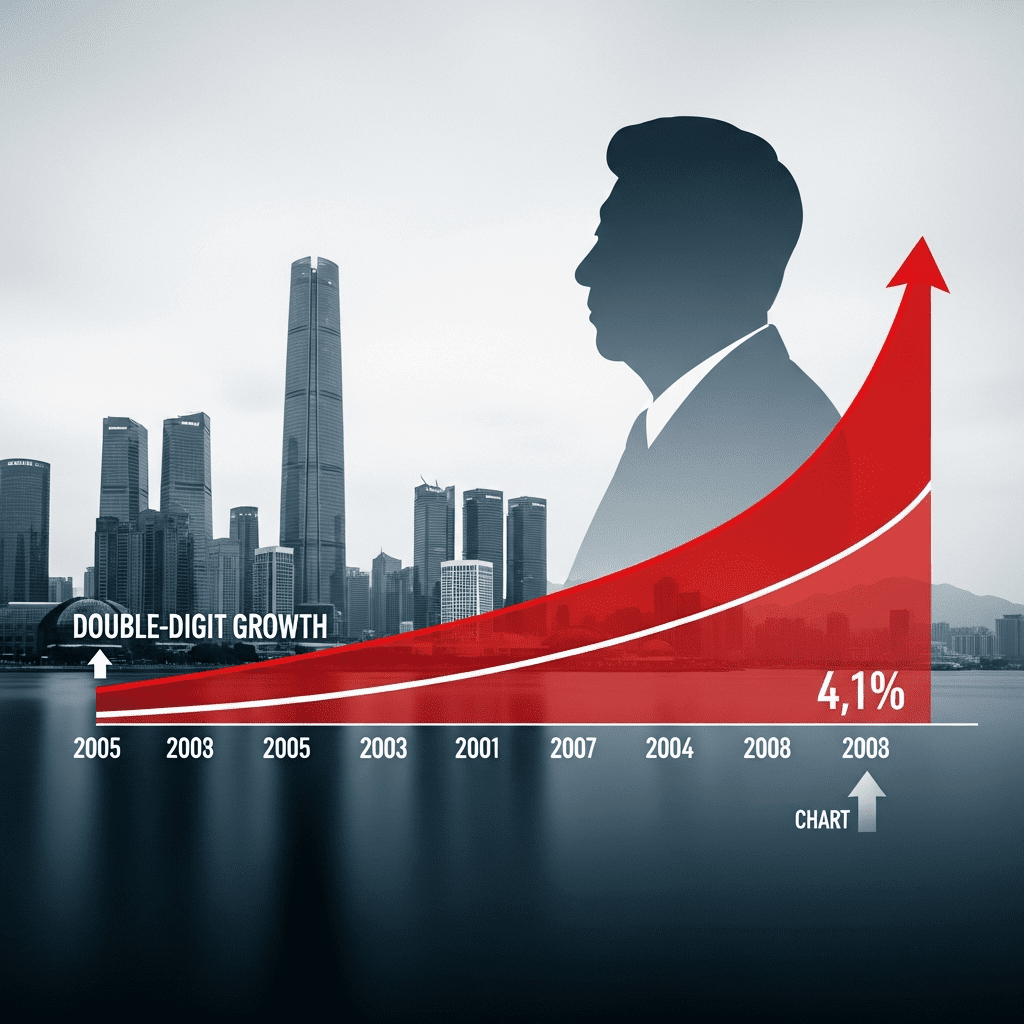
China’s Xi Jinping ($CHINAGOV) revealed an unexpected tolerance for sluggish economic expansion in Guangdong, as the richest province posted just 4.1% GDP growth in Q3 2025. The China Xi tolerates slow growth narrative signals a marked shift in priorities, surprising investors accustomed to historic double-digit gains.
Guangdong’s GDP Growth Slows to 4.1% as Policy Priorities Shift
Guangdong, which accounts for over 11% of China’s GDP, reported a year-on-year GDP increase of only 4.1% in the third quarter of 2025, well below the 2022 average of 5.9%, according to the National Bureau of Statistics (NBS). Export volume dropped 2.4% from Q3 2024 to $370.5 billion, marking its weakest quarter since 2020, per customs data. Provincial industrial output edged up just 3.2%, despite significant stimulus announced earlier in the year. Xi Jinping’s administration has so far refrained from ordering aggressive new stimulus, signaling a focus on sustainable and quality growth rather than an all-out push for expansion. (Sources: NBS, Xinhua, Bloomberg, data accessed November 2025.)
How Guangdong’s Slowdown Impacts China’s Economic Engine
Guangdong’s deceleration reverberates across China’s broader economic landscape. The province’s manufacturing sector, comprising major exporters like BYD Company ($BYDDF) and Tencent Holdings ($TCEHY), saw year-to-date profits down 6.7% versus 2024 levels (NBS). Nationwide, China’s overall GDP growth is on pace for 4.5% in 2025, versus last year’s 5.2%. The services sector—historically a growth driver—expanded by 3.8%, compared to a robust 5.6% in 2023, signaling a system-wide moderation. Analysts note that provincial slowdowns like Guangdong’s dampen consumer sentiment and pressure employment rates, as the region remains a core hub for migrant workers and global supply chains. For context, Guangdong’s export share of total Chinese outbound shipments contracted to 24.5% in Q3, from 26.2% a year ago (China Customs).
Investor Strategies: Navigating China’s Structural Transition
Market participants focused on Chinese equities and supply chain stocks are recalibrating strategies as China Xi tolerates slow growth. Investors holding shares of Guangdong-listed companies—such as Midea Group ($MIDEA) or Ping An Insurance ($PNGAY)—face volatility amid lower earnings. Sector rotation toward technology and domestic consumption—highlighted by Alibaba Group ($BABA) and Meituan ($MPNGF)—has gained favor, reflecting Xi’s emphasis on quality over quantity. Some institutional investors are hedging exposure to traditional export plays while seeking opportunities in health care and green energy, sectors singled out in recent five-year plans. For more on evolving market strategies, see stock market analysis and broader latest financial news.
What Analysts Expect Next for China’s Richest Province
Investment strategists note that Xi’s tolerance for slower provincial growth reflects a larger pivot toward structural reform and risk containment. According to analysts at UBS and Nomura, this posture may keep near-term GDP below consensus targets but supports medium-term resilience by reducing systemic debt and overstretched real estate exposure. Industry observers expect incremental policy support for advanced manufacturing and research and development, rather than broad-based stimulus, in the coming quarters.
China Xi Tolerates Slow Growth: What Investors Should Watch in 2025
China Xi tolerates slow growth in Guangdong signals a decisive policy recalibration investors must monitor. Future catalysts include targeted fiscal support for emerging sectors, RMB stability measures, and any surprise trade policy moves. Investors should assess portfolio risk exposure to China’s evolving economic engine, as robust double-digit growth appears unlikely to return in the short term.
Tags: China, Guangdong, $BYDDF, economic growth, policy shift