




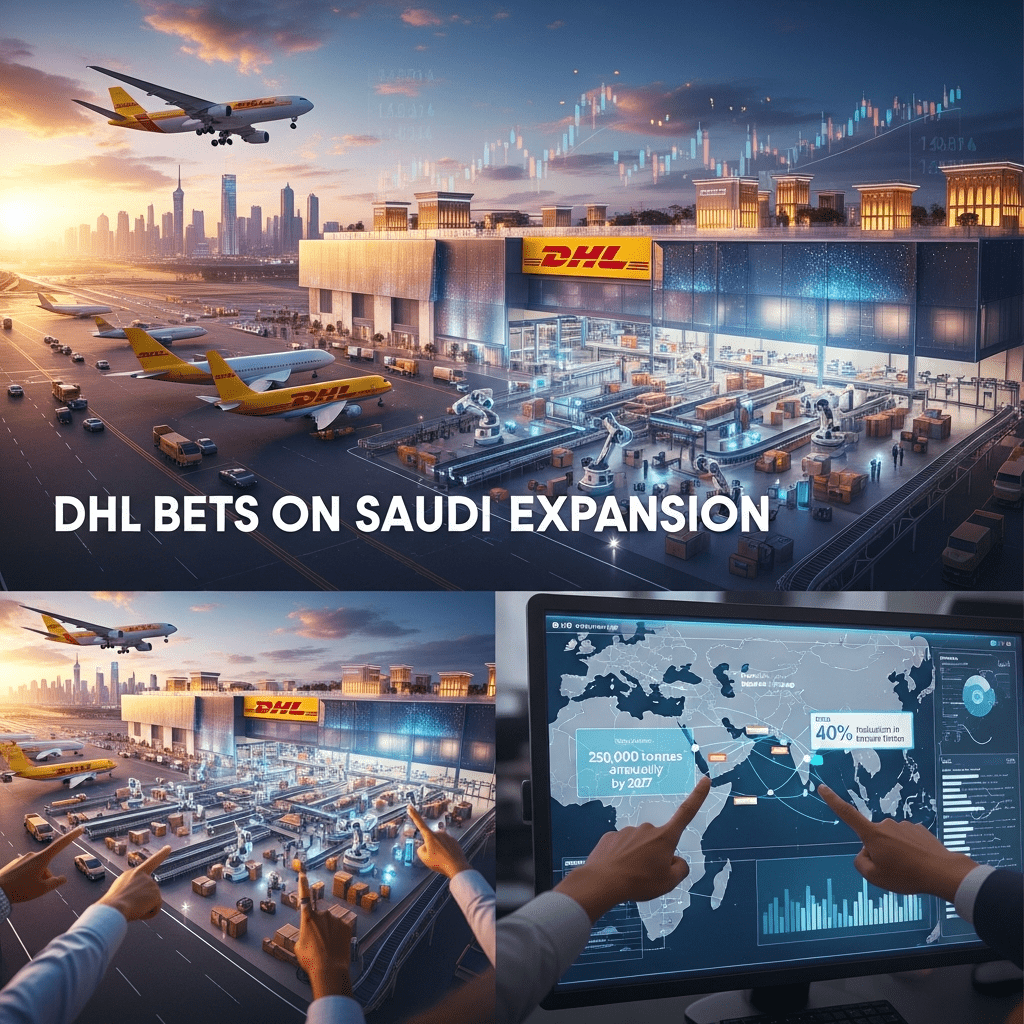
DHL Group ($DPW.DE) surged 2.1% after announcing a $150 million investment in a state-of-the-art Riyadh hub, signaling that DHL bets on Saudi expansion. Investors are weighing how this bold move may accelerate growth and redefine logistics across the Middle East’s fastest-growing market.
DHL Commits $150M to Riyadh: Transforming Logistics in Saudi Arabia
DHL’s ($DPW.DE) latest $150 million pledge places its new Riyadh hub among the largest logistics investments in Saudi Arabia’s history—doubling DHL’s regional capacity to an estimated 250,000 tonnes annually by 2027, according to Reuters. This 35,000-square-meter, fully automated facility is set for completion by Q4 2025, featuring AI-powered sortation and customs processing systems designed to cut turnaround times by 40%.
According to Bloomberg, Saudi Arabia’s non-oil GDP grew 4.8% in Q3 2024, underlining the kingdom’s aggressive infrastructure push under Vision 2030. Deutsche Post DHL Group’s Middle East CEO Oscar de Bok called the project “a strategic anchor supporting regional e-commerce and trade connectivity.” DHL’s expansion is backed by a 25-year land lease agreement at King Khalid International Airport, ensuring stable long-term operation.
The facility’s annual processing volume—up from 120,000 tonnes in 2023—is expected to increase DHL’s Saudi market share from an estimated 18% to over 25% by 2027. “It’s the single largest investment by a global logistics player in the Gulf this decade,” S&P Global analysts told Reuters.
Impact on Gulf Logistics Market and Macroeconomic Growth Trends
The Saudi logistics market, currently valued at $25.1 billion (Statista, 2024), is forecast to reach $35 billion by 2028—a 39% CAGR—driven by rising e-commerce and multimodal connectivity initiatives. DHL’s aggressive expansion aligns with the kingdom’s plan to become a global supply chain hub: the Saudi Logistics Hub Index rose 19% year-on-year in 2024, reflecting growing demand for regional warehousing and trade services.
Rivals including FedEx ($FDX) and UAE-based Aramex ($ARMX.DFM) have also scaled up investments, but none match DHL’s new Riyadh footprint in scale or automation. DHL’s investment comes even as the “Red Sea corridor” shipping disruptions and Houthi attacks limited regional flows throughout 2024, highlighting the need for diversified inland connectivity.
According to the International Air Transport Association (IATA), cargo flows through Riyadh’s airport terminals rose 24% in the first nine months of 2024, outpacing Dubai and Doha. Analyst consensus anticipates overall Gulf logistics volume growth of 7%–9% CAGR through 2028, with Saudi Arabia capturing more than a third of incremental flows thanks to these investments (stock market analysis).
Investor Playbook: Positioning Portfolios for Gulf Logistics Upside
DHL’s ($DPW.DE) Riyadh commitment offers several actionable strategies for global investors. Momentum-driven traders could target Deutsche Post DHL stock, which outperformed the DAX by 6 percentage points year-to-date. Longer-term investors may consider Saudi-listed logistics peers such as Bahri ($4030.SR), up 28% YTD after landing major supply chain contracts.
Exposure to exchange-traded funds (ETFs) focused on emerging markets transportation, such as the iShares MSCI Saudi Arabia ETF ($KSA), offers indirect upside to freight sector growth. However, investors should note currency risk and political volatility; S&P Global warns of persistent regional tensions and evolving regulation as Saudi liberalizes its logistics sector.
For diversification, logistics tech stocks—particularly those leveraging AI for fulfillment—may stand to benefit. Companies like FedEx ($FDX), United Parcel Service ($UPS), and regional players including Aramex are investing in automation, but none currently match DHL’s first-mover scale in Riyadh.
Investors monitoring the logistics stock market trends will note that major customers, including Amazon ($AMZN), have signaled new warehouse and fulfillment agreements with DHL in the Gulf, potentially amplifying revenue streams. For full sector coverage, ThinkInvest’s financial news updates provide ongoing insight into freight, e-commerce, and regional commerce strategies.
Expert Insight: Analyst Perspectives on DHL’s Long-Term Outlook
Leading market strategists see DHL’s Saudi bet as “transformational,” enabling margin expansion and unlocking new cross-border revenue streams. Barclays projected in February 2024 that DHL’s Middle East volumes could grow at an 11% CAGR through 2030, contingent on operational ramp-up and regulatory clarity.
Pre-2025 analyst reports flagged three key benefits: (1) Diversification away from Europe as DHL faces softening e-commerce margins at home; (2) High-GDP-growth exposure, as Saudi Arabia’s Vision 2030 targets a $2.8 trillion economy by 2030 (PIF projections); and (3) Technological leadership, with the Riyadh hub piloting DHL’s next-gen autonomous sortation lines.
However, risks persist. As per Fitch Ratings, geopolitical tensions with Yemen and fluctuating oil prices pose ongoing uncertainties for Gulf logistics operators. Furthermore, analysts caution that labor market constraints and slower-than-expected customs reforms could delay DHL’s anticipated 40% reduction in transit times. Nonetheless, consensus remains that the Riyadh investment is a “clear vote of confidence in the kingdom’s logistics evolution.”
Saudi Logistics Revolution: DHL Bets on Saudi Expansion and Future Growth
DHL bets on Saudi expansion reflects both a short-term tactical shift and a long-term overhaul of regional logistics infrastructure. With $150 million channeled into a next-generation hub, investors are offered a rare chance to participate at the inflection point of the kingdom’s $10 billion annual logistics transformation. For those seeking emerging-market growth, the opportunity is compelling—but prudent portfolio sizing, sector vigilance, and geopolitical awareness will be critical as the competitive landscape evolves (explore investment strategies on ThinkInvest).
DHL’s commitment, mirrored by record cargo data and surging demand, repositions Saudi Arabia as a central node for global trade. As Gulf supply chains modernize, informed investors who follow the marker “DHL bets on Saudi expansion” will gain early access to sector-defining momentum and long-term earnings growth potential.
Tags: DHL, Saudi Arabia, logistics, stock market, Riyadh, Gulf region, supply chain