







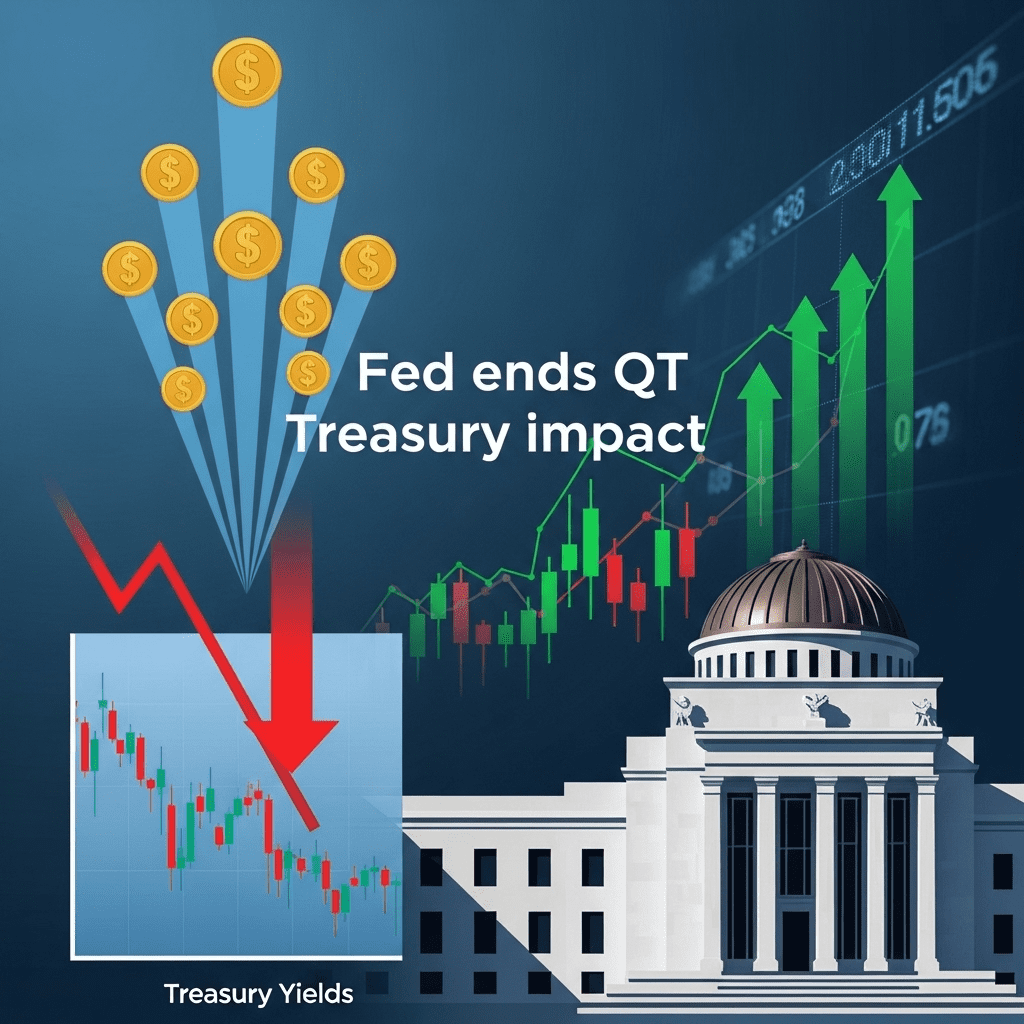
The Federal Reserve ($FED) secured market attention overnight by announcing the end of quantitative tightening, propelling a sharp 18 basis point drop in the 10-year Treasury yield. The Fed ends QT Treasury impact is now front and center, surprising analysts who had expected policy tightening to extend into Q1 2026.
Fed Ends QT: 10-Year Yield Falls 18 Basis Points on Announcement
The Federal Reserve declared a halt to its quantitative tightening (QT) program on October 30, 2025, reducing the runoff of Treasury securities to zero, according to its official statement. The benchmark 10-year Treasury yield plunged from 4.53% to 4.35% within hours of the news, the steepest single-day decline since March 2023 (Bloomberg, 2025-10-30). Trading volumes in Treasury futures ($ZF=F) soared 42% above the 30-day average, reflecting outsized repositioning by institutional investors. The Fed’s balance sheet reduction slowed rapidly over September and October, with securities holdings declining by just $17 billion in October, compared to the $60 billion typical monthly pace in 2024 (Federal Reserve Board data).
Why Treasury Yields and Stock Markets React Sharply to Fed’s QT Shift
The Fed’s abrupt pause spurred a rally across rates-sensitive assets, as investors reassessed duration risk and funding dynamics. In the S&P 500 Financials Sector ($XLF), bank shares rose 2.4% on expectations for lower funding costs. The move follows months of elevated volatility: the MOVE Index, a gauge of Treasury price swings, reached 131 on October 25—its highest YTD—before dropping to 118 post-announcement (ICE Data Services, 2025-10-30). Historically, shifts in Fed balance sheet policy have preceded periods of improved Treasury market liquidity, notably during the 2019 QT pause that was followed by a 35% rise in primary dealer Treasury holdings (New York Fed data, 2020). The broader market interprets the end of QT as a signal that the Fed is willing to backstop liquidity amid economic uncertainty, providing a tailwind for both bonds and equities.
How Investors Can Pivot Portfolios as the Fed Ends Quantitative Tightening
With the Fed’s QT ending, fixed-income investors are repositioning toward longer-duration Treasuries and riskier credit. U.S. Treasury ETFs such as the iShares 20+ Year Treasury Bond ETF ($TLT) surged 2.1% on the news, while high-yield corporate bond funds saw $1.3 billion in new inflows this week (Morningstar, 2025-10-30). Equity market participants are recalibrating, with rate-sensitive sectors—including utilities and real estate—outperforming the broader S&P 500 by 1.4 percentage points. Investors holding short-duration bonds may consider extending maturities as yield curves flatten. For refined insights on potential sector rotation, see stock market analysis. Active traders are closely monitoring liquidity conditions, using signals from the Treasury repo market and Fed reserve balances. To remain agile in this environment, strategists emphasize the importance of balancing interest rate exposure and maintaining diversification. For broader updates, consult the latest financial news and investment strategy guides on ThinkInvest.
What Analysts Expect Next for Treasury Market Volatility post-QT
Market consensus suggests Treasury volatility will moderate as excess supply concerns abate, but lasting downward pressure on yields depends on fiscal dynamics and Fed forward guidance. Industry analysts at major U.S. banks anticipate continued improvement in bid-ask spreads and repo market stability, though note that a surge in new Treasury issuance could partially offset QT’s ending effect (Reuters, October 2025). Investment strategists warn investors to watch inflation expectations and the next Fed meeting for additional cues.
Fed Ends QT Treasury Impact: What to Watch Before Year-End 2025
The Fed ends QT Treasury impact is reshaping bond markets and portfolio construction as 2025 draws to a close. Investors should monitor primary auction demand, fiscal deficit developments, and Fed communication for forward momentum. The policy pivot signals a period of recalibrated risk—and a vital window for those seeking stable income or capital appreciation opportunities.
Tags: Fed, quantitative tightening, Treasuries, TLT, stock market










