





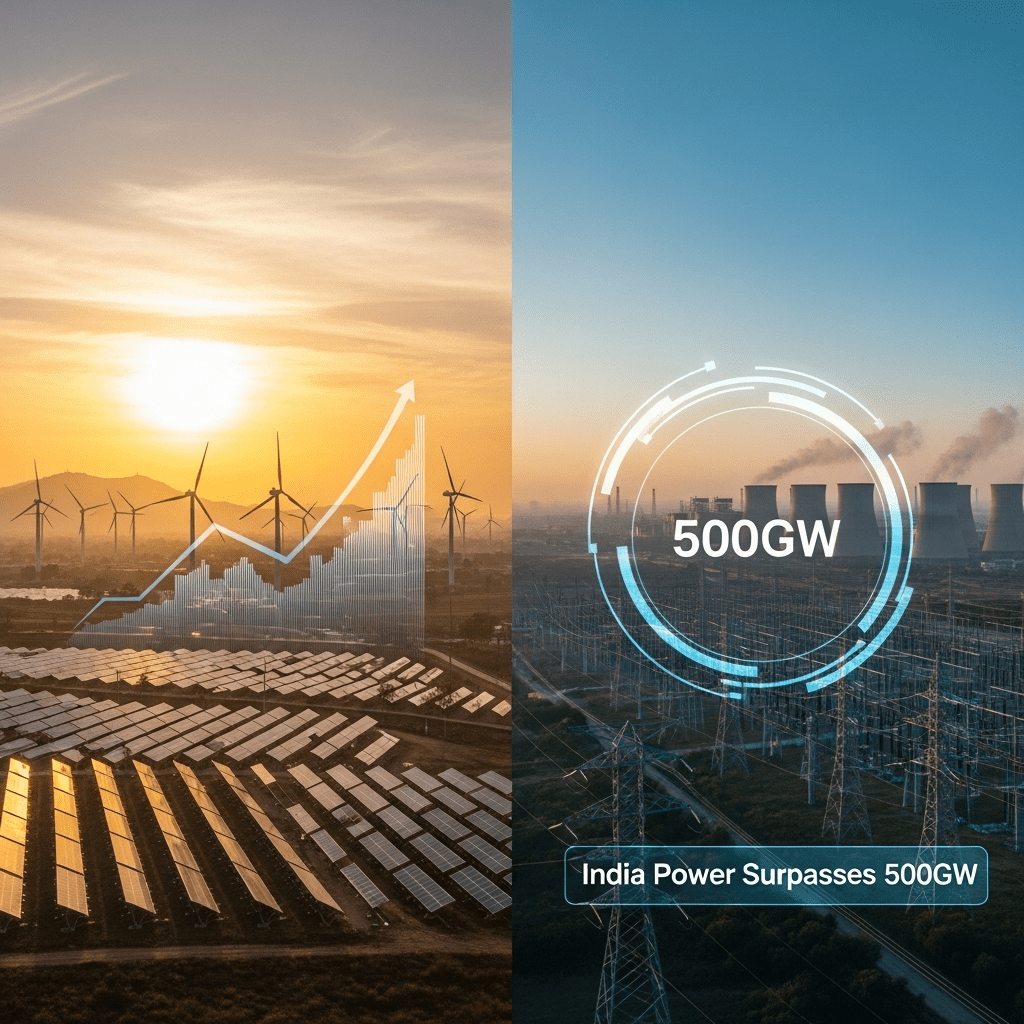
India’s power sector ($BSEPOWER) revealed a stunning milestone this week, as its total installed electricity capacity surpassed 500GW—a first in the country’s history. The phrase ‘India power sector surpasses 500GW’ is now reverberating across Asian energy markets, leaving investors to reexamine demand forecasts and policy risks.
India Achieves Milestone: 500GW Electricity Capacity in 2025
India’s total installed electricity capacity surged to 500.7GW as of October 30, 2025, according to Central Electricity Authority (CEA) data. This marks a sharp 6.1% year-on-year increase from 472GW reported in September 2024. Renewable energy accounts for a record 44% (222GW) of the capacity mix, while coal’s share has slipped to 47% (237GW). The Indian government’s Ministry of Power cited robust private sector investments and policy incentives as key drivers behind the expansion, with nearly 30GW new solar and wind capacity commissioned in the last 12 months alone. India now ranks third globally for total power generation capacity behind China and the United States. (CEA Monthly Report, Ministry of Power statement, October 2025)
How Surging Power Capacity Impacts India’s Energy Markets
This 500GW milestone resonates across India’s broader energy markets, notably compressing wholesale electricity prices on the Indian Energy Exchange (IEX) to ₹4.23/unit in October 2025, down 8% versus the prior-year average of ₹4.60/unit. Analysts attribute this trend to higher renewable integration and improved grid stability. With peak summer demand reaching a record 238GW in June 2025—up 11% year-on-year—the new capacity offers greater supply resilience, cushioning key industrial sectors like manufacturing and IT services from blackouts, according to a CRISIL Research sector note published in September 2025. Historically, such capacity surges tend to stabilize consumer tariffs and attract foreign investment into associated infrastructure.
Investor Strategies as India Energy Stocks React to 500GW Surge
For equity and infrastructure investors, the India power sector surpasses 500GW milestone forces a tactical reassessment. Shares of Adani Green Energy ($ADANIGREEN) and NTPC Ltd ($NTPC) have both advanced over 12% in the past quarter as portfolio flows favor renewable and utility majors. Short-term traders are watching for increased volatility amid regulatory changes, particularly the new draft tariff policy expected to be finalized by December 2025. Long-only investors may consider rebalancing toward utilities and energy sector equities with credible renewable expansion pipelines. Exposure to green bonds—now accounting for $29.5 billion in outstanding debt as of August 2025—offers a hedge as policy incentives continue. For the latest updates on related policy and energy price shifts, explore latest financial news impacting Asian markets. Amid evolving dynamics, international traders monitoring India’s power sector are also tracking the rupee’s sensitivity to energy imports by following forex trading insights for Asia-Pacific currencies.
What Analysts Expect Next for India’s Power Sector Growth
Industry analysts from Morgan Stanley India and CRISIL anticipate that India’s power sector will continue to diversify, with renewables projected to exceed 50% of the mix by 2027 if investment trajectories persist. Concerns remain over grid reliability, given varied regional distribution and legacy coal capacity, but near-term demand growth is forecast at 6-7% annually through 2026. Market consensus suggests robust government incentives—including production-linked incentives for green hydrogen and battery storage—will drive further scale and innovation. (Morgan Stanley Asia note, CRISIL Research, September-October 2025)
India Power Sector Surpasses 500GW: Key Catalysts for Investors Ahead
The ‘India power sector surpasses 500GW’ milestone signals a new era of accelerated capacity additions and renewable investment opportunities. Investors should watch for new policy rollouts, such as the Integrated National Electricity Policy (INEP) due for cabinet review in early 2026, and monitor technology adoption rates in storage and smart grids. Those positioned in energy, infrastructure, and green finance stand to benefit as India’s power sector reforms reshape the demand, price stability, and capital allocation landscape.
Tags: india power sector, BSEPOWER, renewable energy, energy stocks, installed capacity