







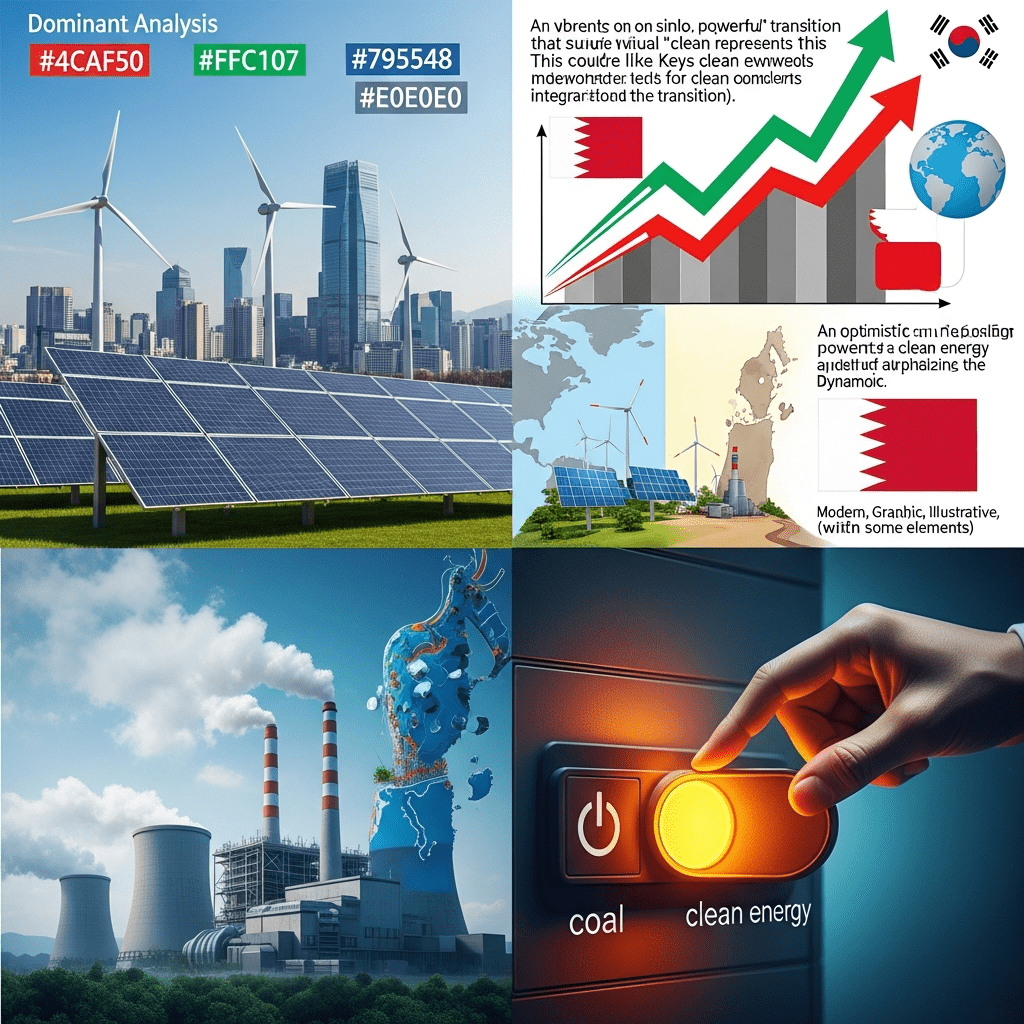
Korea Electric Power Corp ($KEP) traded up 2.1% as Korea and Bahrain join coal-to-clean transition at COP30, a move that signals a new phase for Asia’s legacy energy sector. Investors responded to fresh $27 billion in project commitments, reflecting rising urgency—and surprise—amid decarbonization timelines. What’s next for the regional utilities landscape?
Asia Energy Stocks Surge on Coal Phase-Out Commitments
The 30th UN Climate Change Conference (COP30) in Belém, Brazil, brought sharp swings across Asian energy equities on news that Korea and Bahrain have formally joined the Powering Past Coal Alliance (PPCA). Korea Electric Power Corp ($KEP) shares spiked 2.1% on the day, with Hana Financial Group ($086790.KS) and Doosan Enerbility ($034020.KS) also up over 1.7% and 3.4%, respectively, following the $27 billion pledge to accelerate coal-to-clean infrastructure (Bloomberg, Nov 2025).
Korea, the world’s 7th largest CO2 emitter according to the International Energy Agency (IEA), committed to retiring 20 GW of coal-fired capacity by 2032, a move expected to reduce annual domestic carbon emissions by around 12%. Sources at the IEA estimate this could lower Korea’s coal capacity from 37GW to 17GW within a decade, opening significant opportunities for renewables.
Bahrain similarly agreed to end all coal-power imports by 2028—far ahead of previous regional timelines. The World Bank reports Bahrain imported 5.6 million tons of coal in 2024, primarily for power generation. These commitments, coupled with policy announcements at COP30, drove the S&P Global Clean Energy Index up 1.4% intraday to 2,134, marking its highest close since March 2024 (S&P, Nov 2025).
Reuters highlighted that the cumulative PPCA membership now represents over 27% of global coal-fired power generation, tripling since 2020. The coalition’s new members are projected to catalyze estimated $7.3 billion in clean-tech investments in Asia-Pacific by 2028, accelerating the regional pivot away from coal dependency.
Coal-to-Clean Transitions Reshape Asia-Pacific Energy Sector
Broader market impact was felt across the Asia-Pacific utilities sector. The MSCI AC Asia Utilities Index rose 1.8% after the COP30 announcements. Korean and Bahraini government bonds saw slight spread tightening, reflecting investor confidence in their fiscal stance to support clean energy infrastructure transitions, according to J.P. Morgan’s Emerging Markets research desk (Oct 2025).
IEA’s 2024 World Energy Outlook projected that a rapid coal phase-out in Korea alone could cut regional coal demand by 12% over the next four years. This contraction is expected to pressure major Australian and Indonesian coal exporters, which collectively shipped over 240 million metric tons to Northeast Asia in 2023 (Australian Bureau of Statistics).
Shifting capital allocations are also underway. BloombergNEF recorded $18.6 billion in Asian renewable investment deals in Q3 2025, up 23% year-over-year, citing policy momentum from new transition partners such as Korea and Bahrain. Clean tech manufacturers, from Hanwha Q CELLS ($009830.KS) to KEPCO Plant Service & Engineering ($052690.KS), saw order books swell.
For oil-linked Middle Eastern economies, Bahrain’s move is seen as a headline policy pivot. Analysts at Goldman Sachs note that while Bahrain’s GDP exposure to coal is under 2%, its early exit sends signals across the Gulf for energy sector diversification. In the shadow of OPEC+ production quotas and volatility in liquefied natural gas (LNG) markets, these actions are poised to influence fossil-fuel capital flows globally.
Investor Strategies: Navigating Energy Transition Portfolios
For investors, the coal-to-clean transition offers both risk and reward. Utility majors shift beyond coal-fired assets to renewables (solar, wind, hydrogen), sparking strategic rebalancing in global energy portfolios. Sectors directly exposed to the transition—utilities, industrials, and clean tech—require active analysis of both valuation premiums and policy momentum.
Active managers may overweight names like Korea Electric Power Corp ($KEP), which holds 36% of Korea’s installed generation capacity, benefiting from state-driven investment and favorable cost-of-capital. Hanwha Q CELLS, Asia’s largest solar cell manufacturer, saw its order pipeline triple in the last 18 months (company reports, Q2 2025).
Risk factors remain around stranded assets. Coal miners, particularly in Australia and Indonesia, could see revenue headwinds: Whitehaven Coal Ltd ($WHC.AX) shares lagged, down 3.2%, in Q4 2025 amid contract renegotiations. ETF flows into broad Clean Energy baskets ($ICLN, $QCLN) surged 4.9% month-over-month, per Bloomberg ETF data.
Investors should consider tactical exposure via utilities and clean energy sector ETFs, while managing duration and credit risks for green bonds tied to Asia-Pacific issuers. For deeper insights, view stock market analysis of Asia-Pacific energy stocks or explore recent financial news in global clean tech. Long-term investors may monitor supply chain and regulatory risks, as the transition’s pricing power and cost pass-through will be tested in coming earnings seasons.
Expert Analysis: Decarbonization Timelines and Policy Headwinds
Market strategists project the Korea and Bahrain commitments will quicken Asia’s transition pace but note potential bottlenecks in grid integration and supply chains. The International Renewable Energy Agency (IRENA)’s 2024 Global Renewables Outlook observed Asia’s renewable build-out rate lags EU and North America—54 GW commissioned in 2023 vs. 98 GW in Europe.
McKinsey research (2024 Asia Power Transition) indicated regulatory streamlining and enhanced financing frameworks are needed to absorb approximately $220 billion of regional investment by 2030. Analysts warn delays in new transmission projects or inflated input costs (for polysilicon, copper) may test profit margins for both utilities and OEM suppliers until 2027.
Goldman Sachs’ 2025 Clean Energy note cited Korea’s increased carbon price—rising to $31/ton by 2025—as a tailwind for renewables, but underscored that coal retirement costs could reach $4 billion in annual depreciation and write-downs for Korean power companies. Still, consensus sees the transition as structurally positive for long-duration assets in energy storage and grid infrastructure.
Jamie Hooper, S&P Global Utilities Analyst, sums up: “COP30’s announcements reset market timelines. Investors who anticipate volatility in project deliveries and power pricing will be best positioned for the coming decade.”
Preparing Portfolios as Korea and Bahrain Join Coal-to-Clean Transition
The coal-to-clean transition in Korea and Bahrain sits at the heart of the world’s decarbonization narrative, supporting long-term rebalancing of capital into clean energy and grid assets. As Korea and Bahrain join coal-to-clean transition discussions at COP30, investors can use this momentum to position for growth but must focus on emerging market policy risks and project execution. Engagement with sector leaders and a close eye on carbon price signals—combined with tactical allocations to renewables—can unlock resilience in Asia-Pacific portfolios. For additional strategy updates, review our latest energy market outlooks and sector-specific analysis.
Tags: coal-to-clean transition, COP30, Korea clean energy, Bahrain climate policy, Asia-Pacific utilities










