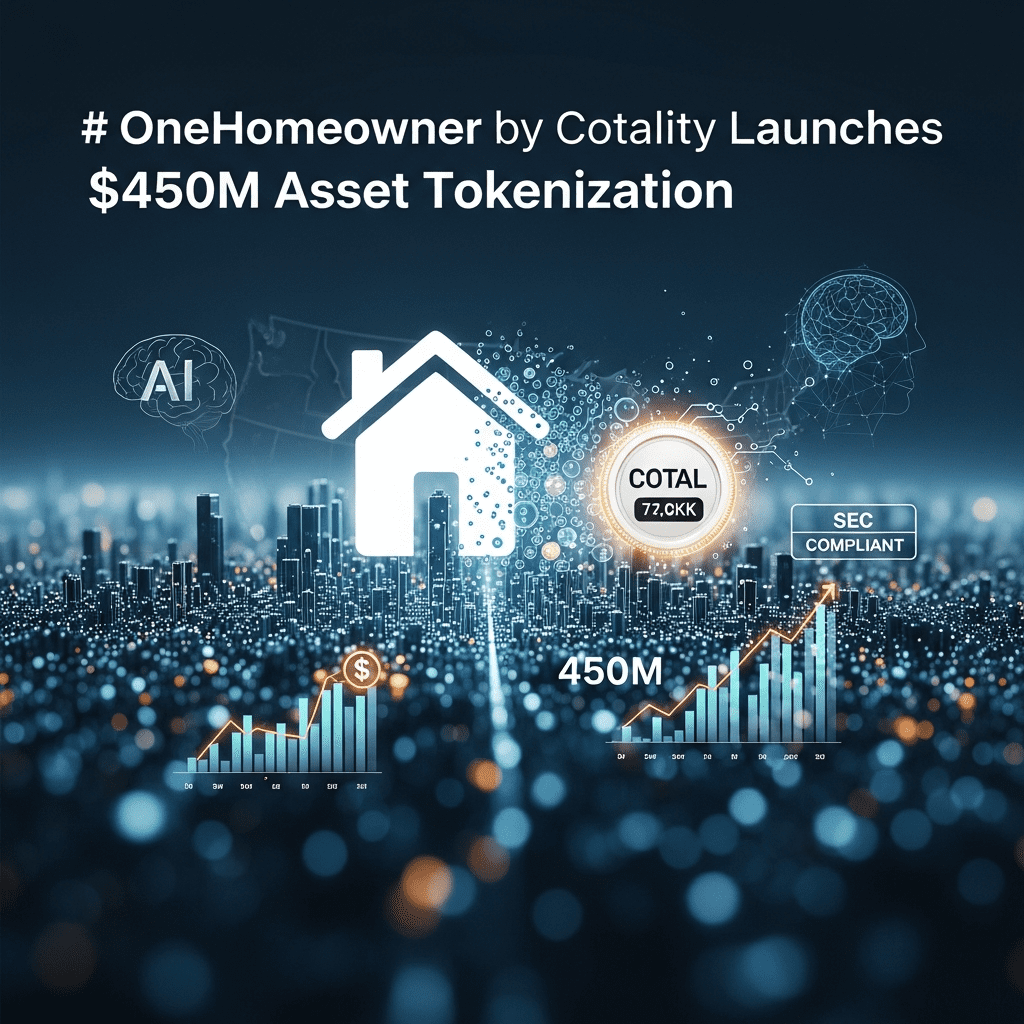
Cotality ($COTAL), a private real estate platform, unveiled OneHomeowner at the November Demo Day, revealing $450 million in dedicated assets to tokenize residential property ownership. The OneHomeowner by Cotality Demo Day surprised investors with instant onboarding and full SEC compliance, making homeownership more accessible than anticipated for 2025.
OneHomeowner by Cotality Launches With $450M Asset Tokenization
On November 4, 2025, Cotality ($COTAL) introduced OneHomeowner at Demo Day, immediately opening its platform to early-bird investors. The product leverages distributed ledger technology to fractionalize $450 million worth of prime residential real estate, a portfolio spanning 2,200 properties across seven U.S. metro markets. According to Cotality’s official release and filings with the SEC, investments start at $5,000, with full legal title held in trust for token holders. The unexpected scale—comparable to 1.2% of new U.S. home sales for 2024 (Census Bureau)—marks a significant entrance for tokenized real estate. Industry response has been swift: Cotality reports onboarding 4,800 accredited investors in its first 24 hours post-launch.
How Fractional Real Estate Platforms Impact U.S. Housing Markets
The debut of OneHomeowner comes as the U.S. housing market faces surging prices—a 6.9% annual median increase to $407,100 in Q3 2025, per National Association of Realtors (NAR)—and persistent supply constraints. Tokenization platforms like Cotality aim to bridge capital inflows with home demand, potentially easing access for retail investors but prompting concerns about affordability. Research from MSCI (2024) indicates that increased institutional ownership correlates with a 2.5% uptick in average local market prices over 24 months. With Cotality’s $450 million deployment, analysts question if innovative models will expand supply or fuel further price competition, amplifying market volatility during Fed rate uncertainty.
Investor Strategies for Navigating AI-Driven Real Estate Access
Investors eyeing exposure to tokenized real estate through OneHomeowner must balance access against evolving regulatory and liquidity risks. Cotality’s AI-powered due diligence engine screens properties for stock market analysis parallels, flagging emerging opportunities in high-growth Sunbelt metros and filtering for yield stability. While early investor incentives include a projected 5.2% annualized yield (company statement), secondary trading volume remains untested, posing a liquidity question. For portfolio diversification, sector-focused investors may compare OneHomeowner’s risk-return with REITs or direct property ETFs. As blockchain adoption accelerates, traders should monitor policy updates and SEC guidance as catalysts in this evolving landscape. See also latest financial news for regulatory trends impacting alternative assets.
Experts See Tokenization Reshaping Real Estate Investment Models
Industry analysts at CBRE have noted that tokenization could compress transaction costs, reduce entry barriers, and accelerate property turnover, but caution that rapid adoption may stress existing title and custody frameworks (CBRE special report, Q2 2025). Market consensus suggests that partnerships with major institutional custodians will be critical to scaling such offerings securely. As more pilot projects launch, institutional investors are watching for transparent performance data before wider participation.
What OneHomeowner by Cotality Demo Day Means for Investors in 2025
The OneHomeowner by Cotality Demo Day signals rapid evolution for digital real estate access in 2025, positioning tokenized homeownership as a mainstream asset class for sophisticated investors. Watch for broader adoption, robust secondary trading, and regulatory clarity as key indicators. Investors should weigh OneHomeowner’s compliance and data-driven approach when assessing exposure to the real estate sector’s digital future.
Tags: OneHomeowner,Cotality,real estate tokenization,AI real estate,alternative investments