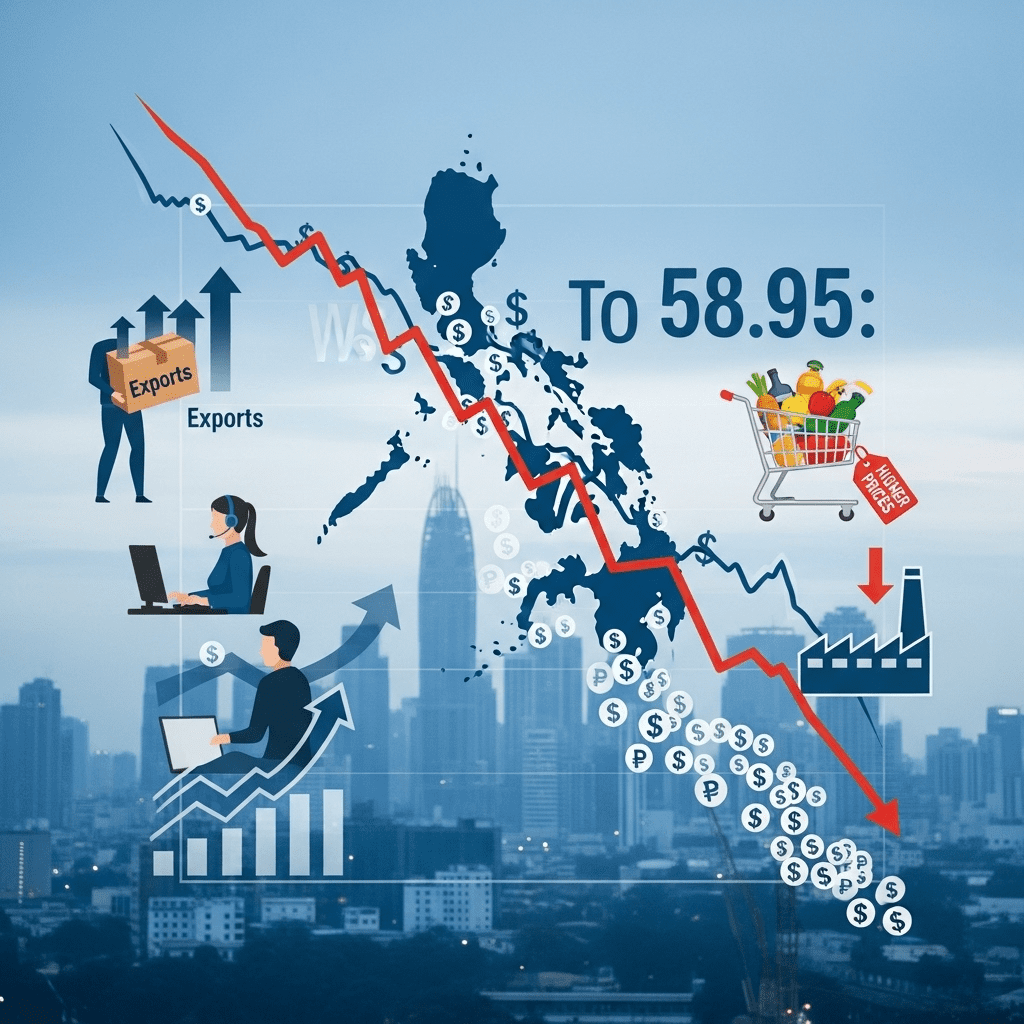
The Bangko Sentral ng Pilipinas ($BSP) revealed the Philippine peso sank to 58.95 against the US dollar on October 29, its lowest level since late 2022. The move reignited concerns about why is the Philippine peso so weak as traders and businesses brace for more volatility. Who stands to benefit from the currency’s ongoing slide?
Philippine Peso Drops 7% YTD as Dollar Demand Accelerates
The Philippine peso slid 7% year-to-date, from 54.91 on January 2 to 58.95 per US dollar as of October 29, 2025, according to data from the Bankers Association of the Philippines. This latest depreciation echoes the currency’s lows last seen in September 2022, when it briefly touched 59.01.
Stronger-than-expected US economic data and rate hikes from the Federal Reserve fueled global dollar demand, while the Philippines faced persistent trade deficits—imports rose 5.2% YoY to $12.2 billion in August, outpacing export growth capped at 2.7% ($7.8 billion), per Philippine Statistics Authority data released October 2025.
Remittance inflows traditionally support the peso, but September’s $2.82 billion (up just 2.6% YoY, Central Bank report) failed to offset surging corporate dollar demand and risk-off sentiment among foreign investors.
How Peso Weakness Impacts Stocks, Inflation, and Local Markets
Peso depreciation brings mixed implications for key sectors. Import-dependent industries—consumer goods, manufacturing, transportation—face higher costs as raw materials and fuel become more expensive. The Philippine Stock Exchange Index ($PSEi) declined by 4.7% in October, led by declines in retail and airlines, reflecting concerns over margin pressures.
Conversely, exporters and the business process outsourcing (BPO) sector benefit; local revenues from US dollar payments rise in peso terms. The listed BPO giant Converge ICT Solutions ($CNVRG) reported an 8.1% YoY increase in Q3 revenues, partially attributed to currency effects (company statement, October 2025). Meanwhile, inflation accelerated to 5.8% in September—above the BSP’s 2-4% target—as a weaker peso raised the cost of imports, especially food and energy (Philippine Statistics Authority).
Strategies for Investors Navigating Peso Volatility in 2025
For equity investors, currency weakness suggests a defensive posture toward import-heavy sectors and a selective focus on exporters, BPOs, and firms with significant dollar revenues. Companies like International Container Terminal Services ($ICT) and Universal Robina ($URC) offer some hedge against the peso slide.
Traders exposed to the forex trading insights market monitor peso-dollar volatility, seeking tactical opportunities as the Philippine peso continues its decline.
Bondholders are weighing the risk of further depreciation eroding local returns—some are shifting to US dollar-denominated Philippine sovereign or corporate bonds. Staying updated on latest financial news and stock market analysis can help investors capture sector winners and avoid pitfalls. Near-term, watching central bank intervention signals and remittance flows will be critical for positioning portfolios.
What Analysts Expect Next for the Philippine Peso and Markets
Analysts at HSBC and ING, cited by Bloomberg in October 2025, suggest persistent current account deficits and US rate policy will keep the peso under pressure through year-end. Industry strategists expect the BSP to defend the currency using its $98.6 billion in forex reserves but caution that aggressive hikes may risk choking growth.
Market consensus indicates currency volatility will remain elevated, particularly if US yields stay high and foreign direct investment inflows stall. Many experts believe the peso will stabilize only if global risk appetite rebounds and the Philippines narrows its trade gap.
Peso Weakness Signals New Dynamics for Investors in 2025
Sharply diverging sector fortunes and renewed inflation mean why is the Philippine peso so weak is more urgent for investors than ever. Upcoming US policy moves, holiday remittance surges, and local trade balances will be key catalysts to monitor. Active portfolio management is critical as peso weakness reshapes market opportunities and risks in Q4 2025 and beyond.
Tags: Philippine peso, forex, stock-market, PSEi, currency volatility