





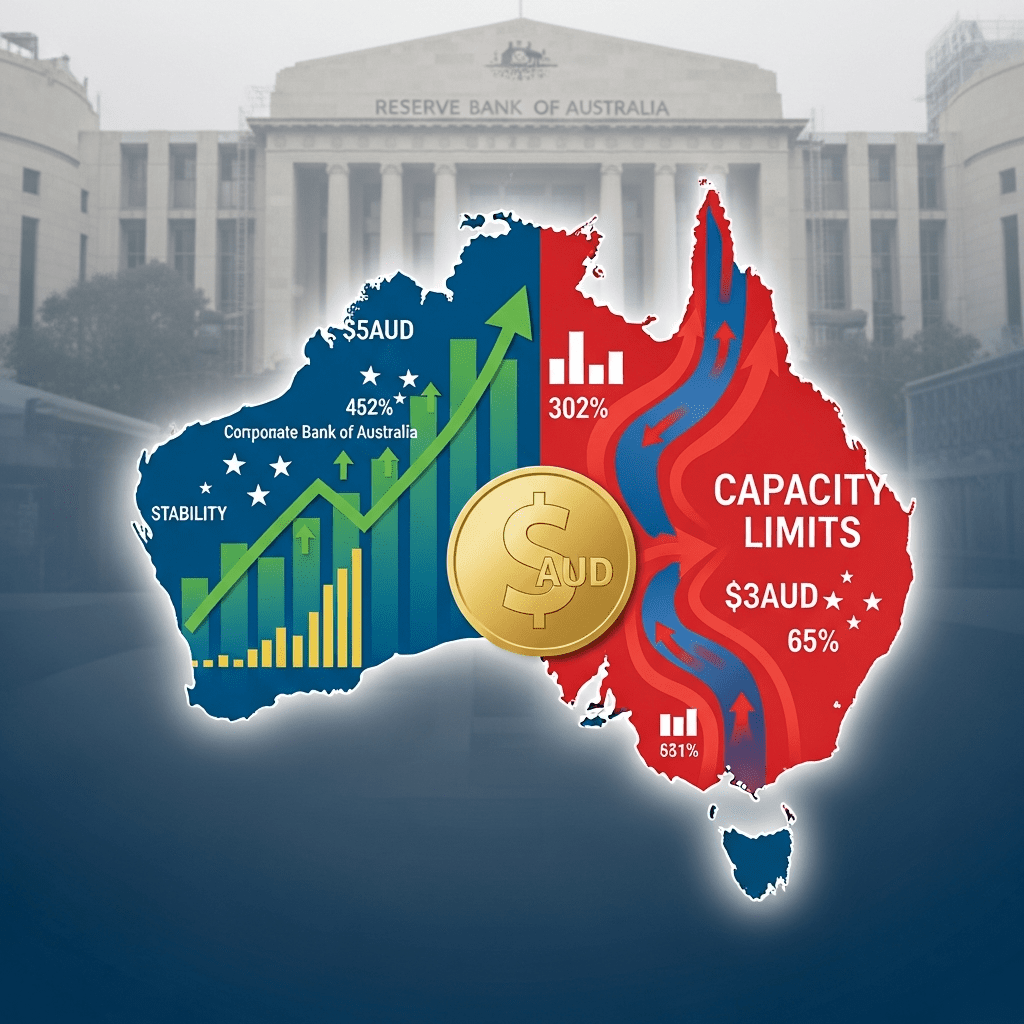
Reserve Bank of Australia ($RBA) Deputy Governor Andrew Hauser revealed that the RBA economy capacity limits are posing acute challenges for monetary policy, as inflation remains stubbornly above target. Investors were surprised by his warning despite June’s steady cash rate, questioning policy flexibility as growth slows but labor markets remain tight.
RBA’s Hauser Flags Policy Constraints With Inflation at 3.6%
Hauser signaled on November 9 that persistent RBA economy capacity limits will constrain Australia’s policy response, especially as headline inflation remains at 3.6% year-on-year as of Q3 2025, well above the RBA’s 2-3% target (source: Australian Bureau of Statistics). With GDP growth slowing to 1.8% on an annualized basis and the unemployment rate at a low 4.1% in October (source: Bloomberg), the RBA held its cash rate steady at 4.35% in June. Hauser’s comments indicate limited scope to stimulate growth without reigniting inflationary pressures—contrary to expectations that rate cuts might soon be on the table.
Why Labor Market and Capacity Constraints Are Shaping the Economy
Australia’s labor market resilience, with participation rates near historic highs at 66.7%, underscores ongoing skills shortages and capacity constraints. According to the NAB Monthly Business Survey (October 2025), 58% of firms cite labor as a major constraint. At the same time, job vacancy rates remain more than 30% above their pre-pandemic trend. Persistent capacity pressures have kept services inflation above 4%, compounding cost pressures in sectors like construction and healthcare. This dynamic highlights how RBA economy capacity limits ripple into broader market performance, restraining potential rate relief even as growth moderates.
How Investors Should Adjust Portfolios as Policy Shifts Loom
Investors in interest-rate sensitive assets—including Australian bank stocks such as Commonwealth Bank of Australia ($CBA) and property-linked REITs—face elevated uncertainty. Persistent RBA economy capacity limits imply that forecasts of early rate cuts may be premature, especially with inflation sticky in the services sector. Market expectations for a rate reduction have shifted from March to late Q3 2026, as tracked by ASX 30-Day Interbank Cash Rate Futures.
Equity strategists at UBS recommend maintaining exposure to defensive sectors such as healthcare and staples given downside growth risks. Fixed-income investors may favor shorter duration bonds, reducing exposure to rate volatility. For more on positioning portfolios, see our investment strategy hub and dive into stock market analysis for the latest sector trends.
Analysts Predict Persistent Tightness for RBA’s Policy Path
Industry analysts observe that Australia’s structural labor and supply bottlenecks will likely persist into 2026, reinforcing the RBA’s cautious stance. According to J.P. Morgan’s September 2025 Asia Pacific Market Outlook, sustained migration and delayed business investment are expected to keep unemployment low and operating capacity stretched. Market consensus suggests that unless productivity improves sharply, easing policy risks reigniting inflation—leaving the RBA little room to maneuver for now.
RBA Economy Capacity Limits Signal New Era for Investors
RBA economy capacity limits are set to define monetary policy debates through 2025 and beyond. Investors should closely monitor wage growth, migration flows, and sectoral inflation as key signals for the central bank’s next moves. In an environment marked by policy constraints, selectivity and flexibility in portfolio construction will be essential to navigate ongoing volatility.
Tags: RBA, Australia, inflation, capacity-limits, interest-rates