







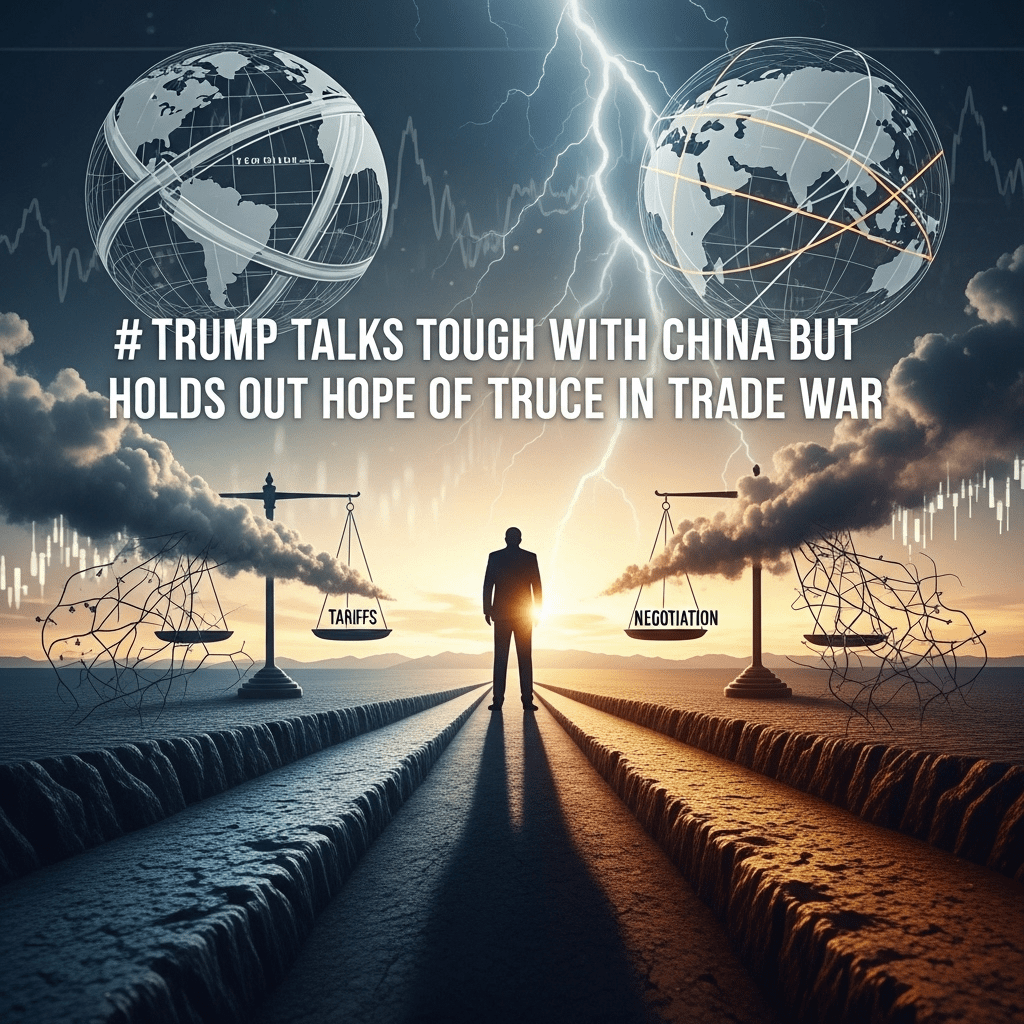
As “Trump talks tough with China but holds out hope of truce in trade war,” global markets and policymakers are closely analyzing what this balancing act could signal for the 2025 economic landscape. Investors and business leaders are keenly watching for hints about whether President Trump’s hardline rhetoric will result in lasting tariffs or finally pave the way for a long-awaited trade agreement between the world’s two largest economies.
Trump Talks Tough with China but Holds Out Hope of Truce in Trade War: What’s at Stake?
The renewed confrontation between the United States and China reached new heights in early 2025, as President Trump’s administration introduced a series of tariff threats targeting Chinese imports. At the same time, Trump has continued to voice optimism for reaching a trade truce, sending mixed signals to Wall Street and international partners.
For global investors, these developments create both uncertainty and opportunity. While strict tariffs can hurt multinational corporations and disrupt supply chains, a breakthrough in negotiations may restore confidence in global trade. As explored in our emerging markets analysis, the US-China economic relationship serves as a powerful barometer for worldwide economic health.
Key Issues Dominating the 2025 U.S.-China Trade Dialogue
The current phase of the trade war is defined by several pressing issues. Intellectual property protection remains a sticking point, with U.S. officials demanding stricter enforcement by Beijing. Additionally, tariffs on key sectors such as technology and agriculture have escalated tensions, putting pressure on both American farmers and Chinese manufacturers.
Despite the fiery rhetoric, both sides recognize the economic incentive to deescalate. China faces slowing GDP growth and a volatile yuan, while U.S. companies worry about increased operational costs and supply chain delays. As highlighted in our coverage of supply chain risks, these cross-border challenges are reshaping strategy for companies of all sizes.
Investor Sentiment Amid Trade War Uncertainty in 2025
With Trump talking tough but showing willingness for a truce, market sentiment has swung between risk-off and renewed optimism. The S&P 500 and Asian indices have experienced sharp fluctuations every time new tariffs or negotiation updates are announced. Key sectors impacted include semiconductors, automotive, and consumer electronics, all of which depend on seamless global trade.
Recent surveys of institutional investors indicate a cautious approach: moving assets toward resilient sectors, increasing cash reserves, and exploring alternative investments that might outperform during periods of volatility. For those seeking deeper analysis, our investment strategy resources discuss defensive portfolio positioning in uncertain times.
Potential Scenarios: Truce or Escalation?
Looking ahead, two primary scenarios could unfold. In one, tough talk from the Trump administration results in a breakthrough, with both countries agreeing to lower tariffs and establish clearer rules on technology transfers. This outcome could boost equities and unleash pent-up corporate investment.
Alternatively, failed negotiations could prolong the trade conflict, resulting in retaliatory measures and increased economic decoupling. This would likely hamper global growth forecasts and introduce elevated market volatility throughout 2025.
The Global Ripple Effect of U.S.-China Trade Policy
The effects of the U.S.-China trade dispute extend far beyond bilateral relations. As Trump talks tough with China but continues to express belief in a truce, allies and trading partners in Europe, Southeast Asia, and Latin America are recalibrating their strategies. Many countries are seeking new trade deals and diversifying supply chains to buffer against further shocks.
Foreign direct investment patterns are already shifting, with some multinationals relocating manufacturing from China to Vietnam, India, or Mexico. Financial institutions are monitoring currency fluctuations as part of their risk management strategies, aware that a misstep in trade diplomacy could ripple through currency and commodity markets worldwide.
Conclusion: Watchfulness as 2025 Unfolds
As the narrative of “Trump talks tough with China but holds out hope of truce in trade war” continues to evolve, vigilance will be key for investors, policymakers, and executives. While the rhetoric is heated, the logic for a deal remains strong for both parties—suggesting a resolution may eventually be in reach. Until then, adapting to volatility with informed, flexible strategies will remain crucial in a rapidly shifting global economy.










